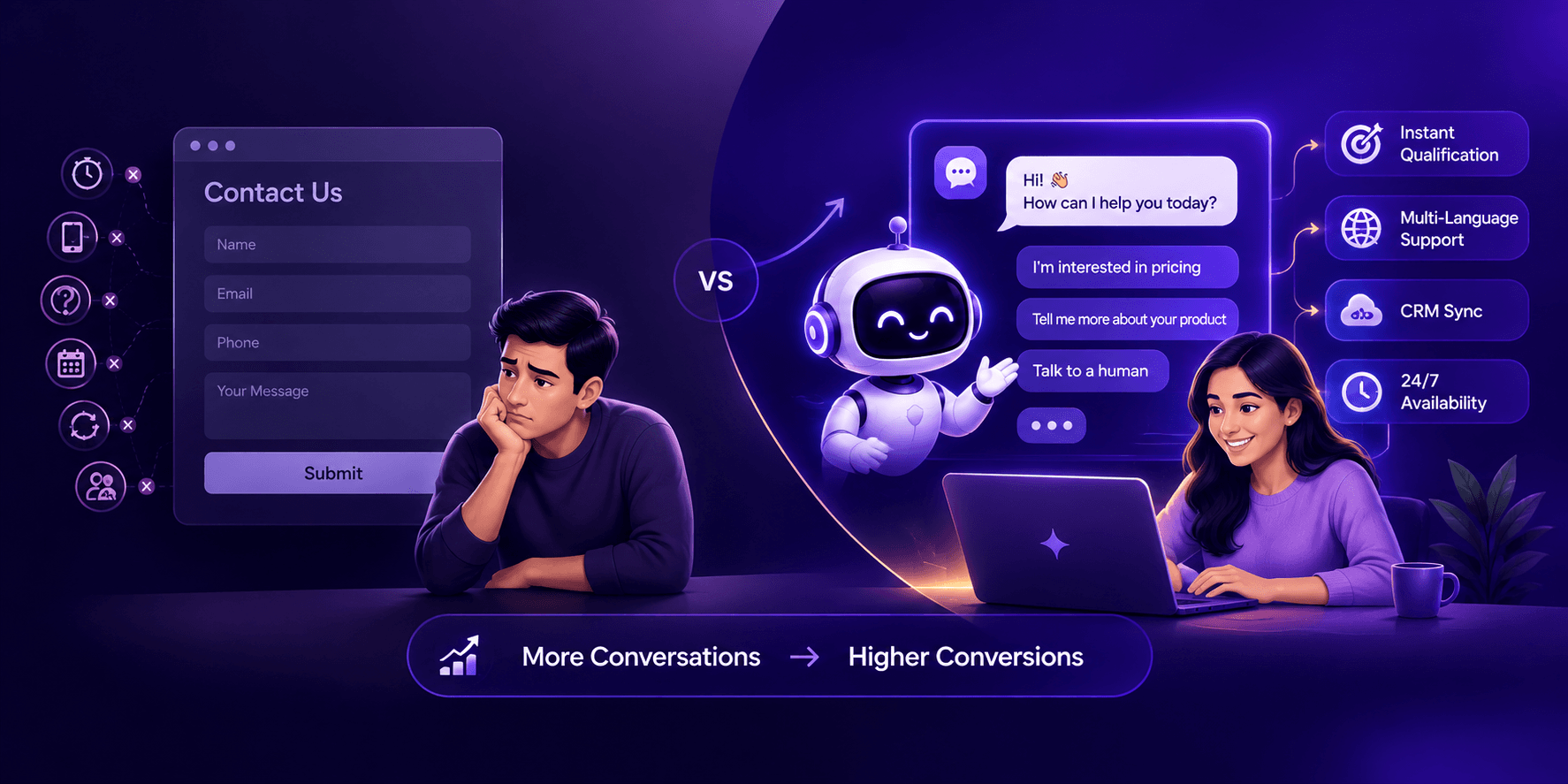
The shape of trust: Gestalt principles at work
Gestalt psychology, the study of how the human eye and mind group visual elements into a coherent whole, explains a large part of why a chat interface feels warmer before a single word is even read.
A form field is a closed shape. Straight edges, hard corners, a fixed height, it visually communicates a container that must be filled correctly or rejected. There is no ambiguity in what a form demands, and that is precisely the problem. Human perception reads sharp, rigid, closed shapes as formal and impersonal, the same visual grammar used in legal documents and tax forms.
A chat bubble uses curved edges and asymmetry, both of which the eye reads very differently. Curved shapes are consistently perceived as friendlier and safer than angular ones, a finding replicated across product design and packaging research for decades. The small tail on a chat bubble, pointing back toward its source, activates the Gestalt principle of continuity, the mind's tendency to follow a visual line back to where it came from, and in doing so it reinforces that there is a “someone” on the other end of the message, not just an empty field waiting for input.
Spacing matters just as much. Chat interfaces use the Gestalt principle of proximity deliberately: messages from the same speaker cluster close together, while a gap separates each turn in the conversation. This visually mirrors the natural rhythm of real dialogue, pause, response, pause, response, in a way a static form, which presents every field at once with no rhythm at all, simply cannot replicate.
A rectangle with a thin grey border and a floating label reads as clinical. A rounded bubble with a little tail pointing toward the person who spoke reads as a voice. Same screen, same visitor, completely different emotional register.
The Fogg Behavior Model: why warmth also means higher conversion
Design psychology does not stop at what feels pleasant. Dr BJ Fogg's Behavior Model, developed at Stanford, holds that a behavior only happens when three things converge at the same moment: motivation, ability, and a prompt. Miss any one of the three, and the behavior does not occur, no matter how much a business wants it to.
A static form asks a lot of “ability” all at once. Every field is a small task, and the more fields a form has, the more the required ability rises, which is precisely why conversion collapses as field count increases. The form also offers a single, blunt prompt: fill me in, submit. There is no adjustment for a visitor who is not yet ready to commit that much effort.
An AI based chatbot restructures the entire equation. Because it asks one thing at a time, in conversational language, the ability required at any single moment stays low even though the total information gathered may be the same as a long form. Because it responds and re prompts contextually rather than displaying every field up front, it can meet a visitor exactly where their motivation currently sits, answering a question first when motivation is low, moving to qualification when motivation is confirmed. This is design psychology solving a conversion problem, not just an aesthetic one.
| Fogg ingredient | Static form | AI based chatbot |
|---|---|---|
| Ability | Every field is visible at once, so the effort required peaks immediately. Completion falls from around 23 percent at 3 fields to under 7 percent at 10 or more. | One question at a time in natural language, so the effort at any single moment stays low even when the same information is eventually gathered. |
| Motivation | Fixed. The form cannot tell the difference between a visitor who is ready to buy and one who is still deciding. | Read and adapted to live. It can answer a question first when motivation is low, then move to qualification once interest is confirmed. |
| Prompt | A single blunt instruction: fill me in, submit. | Contextual and repeated, re prompting in response to what the visitor has just said. |
Warmth is also behavioural, not just visual
The feeling of warmth a chatbot creates is not purely about shape. It is reinforced by how the system behaves once a visitor starts typing.
Research on chatbot design has found that when a conversational agent responds with self-disclosure, offering something first rather than only extracting information, users reciprocate with deeper engagement and describe the interaction as more enjoyable. A separate study on anthropomorphic conversational agents found that emotional attunement, meaning the system's tone and pacing genuinely matching what the visitor needs in the moment, is the specific mechanism that drives increased trust, more so than surface level personality traits alone.
This is where the difference between an AI based chatbot and a script based one becomes a design failure, not just a technical one. A script based bot can wear the same rounded bubble, the same warm colour palette, and the same friendly avatar as an AI based one, but the moment a visitor asks something outside its fixed script, the illusion breaks immediately. The visual warmth becomes a broken promise, and research on poorly implemented automated chat shows this kind of failure drives visitors away faster than a plain form would have. Warmth that is only skin deep does more damage than no warmth at all.
An AI based chatbot, one that actually understands intent and can respond meaningfully across a wide range of real phrasing, is what allows the visual design and the underlying behaviour to stay consistent with each other. The bubble looks like it is listening because the system underneath genuinely is.
Colour and tone: the layer most businesses get wrong
Colour psychology is well documented in branding, but it is applied inconsistently in chat design. A launcher button in a business's brand colour, a message bubble in a slightly lighter tint of the same palette, and a typing indicator that mimics the natural pause of a real reply, all of these are small signals that compound into a feeling of a considered, present system rather than a form dressed up as a chatbot.
The absence of visible waiting time matters here too. Website visitors already operate with short patience windows online, with average attention on a single page now closer to 47 seconds than the 2.5 minutes measured two decades ago. A chat interface that shows a typing indicator during the few seconds an AI chatbot needs to formulate a grounded, accurate answer uses that brief wait productively, signalling responsiveness rather than silence, which is exactly what a static form cannot do at all.
Motion and micro-interactions: the detail most designs skip
There is one more layer of design psychology worth naming, because it is where most businesses that copy the “chat bubble look” fall short without realising why.
A static form communicates entirely through its resting state. Nothing moves, nothing changes, until the visitor acts on it. A well designed AI chatbot communicates continuously, through subtle motion: a message that fades in rather than snapping into place, a typing indicator that pulses gently while a response is being formed, a launcher icon that offers a small, non intrusive animation to signal presence without demanding attention.
These micro-interactions matter because human perception is highly tuned to detect motion as a signal of life. A still object reads as inert. A softly animated one reads as attentive, even before any words are exchanged. This is why a chatbot that opens with a small, natural pause before its first message, rather than appearing instantly, tends to feel more considered than one that fires an instant, robotic looking greeting the moment the page loads. The pause mimics the natural rhythm of a person deciding what to say, and the mind reads that rhythm as presence rather than automation.
The risk, again, is the same one that runs through every layer of this discussion. Motion design can be copied by a script based system just as easily as by a genuinely AI based one. The difference only becomes visible the moment a real, unscripted question is asked, and it is at that exact moment that the underlying AI, not the animation, determines whether the warmth the interface promised was genuine.
Applying this to MagicFlow AI
MagicFlow AI's approach to widget design follows this same logic deliberately. The chat launcher and message window are built to match a business's brand colours and voice rather than sitting on the page as a generic, unbranded overlay, because visual consistency with the rest of the site reduces the sense that the visitor has left a trusted environment. The conversation itself is grounded in a retrieval based knowledge system built from the business's own website and documents, so the warmth of the interface is backed by an AI that can actually follow through on what the design promises, rather than defaulting to a canned response the moment a question falls outside a script.
This pairing, considered visual design plus a genuinely AI based conversational engine underneath, is what separates a chatbot that feels warm and converts from one that looks friendly and quietly damages trust the first time it fails to understand a visitor.
The takeaway
The warmth a well designed AI chatbot creates is not incidental. It is the product of specific, well studied design psychology, curved shapes over sharp edges, one prompt at a time instead of a wall of fields, tone and pacing that respond to the visitor rather than a fixed script, all of it working together with an AI system capable of actually delivering on what that design promises.
Get the visual design right without the AI underneath to match it, and you have built a chatbot that looks warm and behaves like a trap. Get both right together, and you have replaced your least trusted page with your most effective one.
- Wonderchat, The B2B Website Conversion Benchmark Report 2026 https://wonderchat.io/blog/b2b-website-conversion-report-2026
- Conferbot, Chatbot vs Forms: Which Gets More Leads? 2026 https://www.conferbot.com/blog/chatbot-vs-forms
- wpseoai, What is the conversion rate of chatbots? https://wpseoai.com/blog/what-is-the-conversion-rate-of-chatbots/
- BJ Fogg, Fogg Behavior Model https://www.behaviormodel.org/
- The Decision Lab, Fogg Behavior Model https://thedecisionlab.com/reference-guide/psychology/fogg-behavior-model
- Digital Applied, Form Conversion Rate Benchmarks 2026: 100+ Data Points https://www.digitalapplied.com/blog/form-conversion-rate-benchmarks-2026-data-points
- ResearchGate, User perception and self-disclosure towards an AI psychotherapy chatbot according to the anthropomorphism of its profile picture https://www.researchgate.net/publication/374239180
- arXiv, Dialoging Resonance: How Users Perceive, Reciprocate and React to Chatbot's Self-Disclosure in Conversational Recommendations https://arxiv.org/pdf/2106.01666
- Collabra: Psychology (UC Press), The Effects of AI Anthropomorphism on Trust and Responsibility https://online.ucpress.edu/collabra/article/12/1/161757/218332
- Wonderchat, citing Qualtrics 2026 AI customer service failure rate research https://wonderchat.io/blog/b2b-website-conversion-report-2026
- Contentsquare, The average time spent on websites: 3 tips, citing Dr Gloria Mark's attention span research https://contentsquare.com/blog/average-time-spent-on-websites-is-dropping/
Common questions from this article.

Head of Digital Marketing, MagicWorks IT Solutions
Purva Desai is the Head of Digital Marketing at MagicWorks IT Solutions, bringing 16 years of experience across visual arts and digital strategy. A trained artist with a Master's in Visual Art and a background in art therapy, she began her career as a graphic designer, later working as an Art Director before moving into performance marketing, SEO, and brand strategy. This dual foundation, art and analytics, shapes how she approaches marketing: understanding not just what drives clicks, but what drives human perception and emotion. She now leads MagicWorks' digital marketing department, writing on AI, buyer psychology, and the evolving intersection of creativity and data in marketing.