Saying less is not the same as being curt
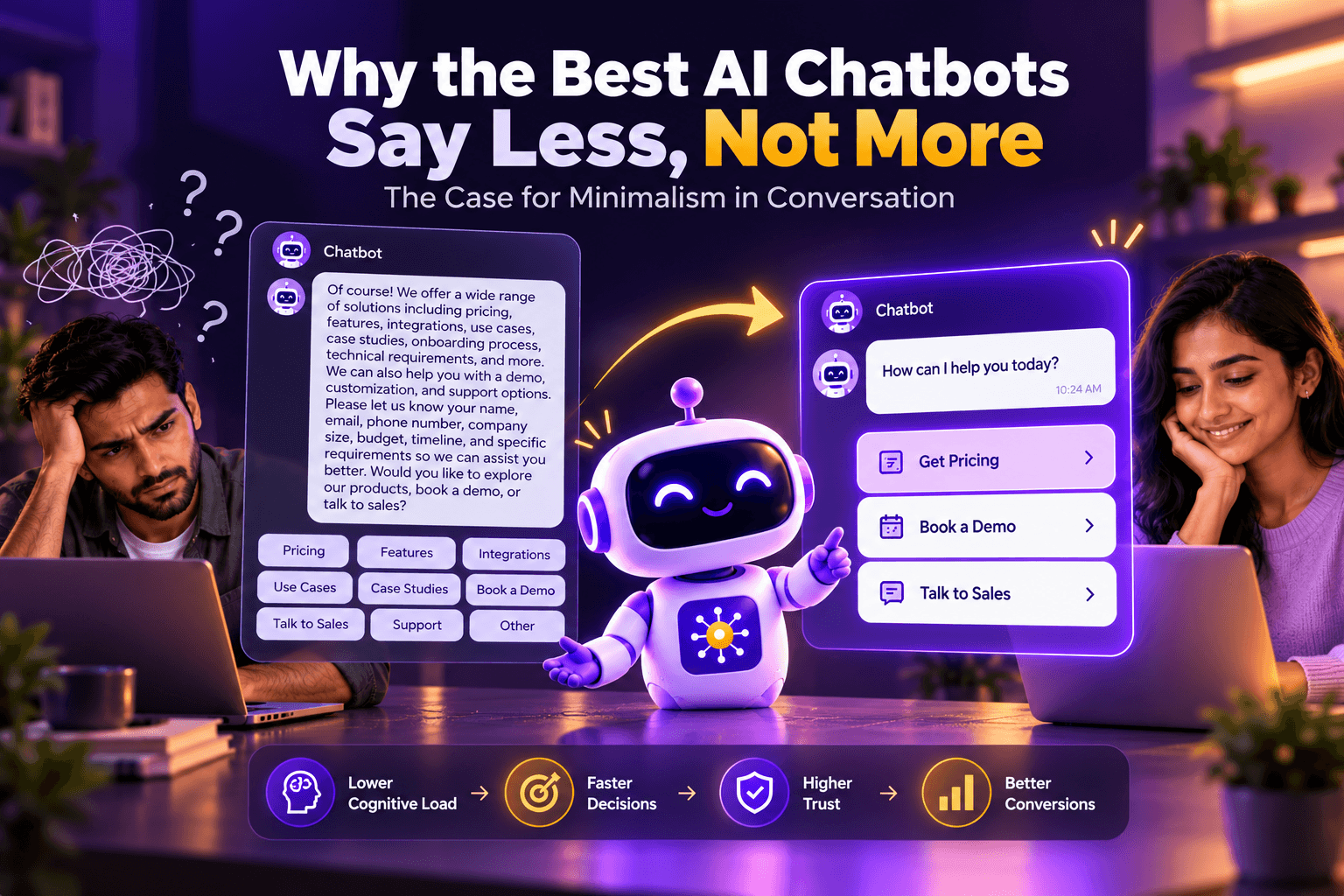
Before going further, it is worth separating minimalism from rudeness. A chatbot that replies "Yes." to every question is not minimal. It is unhelpful. Minimalism in conversation means that every sentence earns its place, and that nothing a visitor needs is hidden behind nothing they asked for.
A useful way to think about it is to picture a good shopkeeper. When a customer walks in and asks where the notebooks are, the shopkeeper points to the shelf. She does not recite the entire inventory, explain the history of paper, and then ask for the customer's phone number. She answers, she watches the customer's reaction, and she says more only if the customer wants more.
That is the standard an AI based chatbot should meet. The visitor sets the depth of the conversation, and the chatbot follows.
The aesthetics of negative space in conversation
Japanese design has a concept called ma, which refers to the meaningful interval between things: the pause in music, the empty space in a room, the silence between two lines of speech. In this tradition, the gap is not an absence. It is part of the composition.
Conversation has its own version of ma. In a chat interface it shows up in three places.
The length of each message
A short reply leaves room for the visitor to respond. A long one takes the whole stage.
The rhythm of turns
One question, one answer, one question. The alternation is what makes it feel like a conversation instead of a broadcast.
The pause itself
A brief, natural delay before a reply signals that someone, or something, is considering what was said.
That last point has support beyond design intuition. A study published at the European Conference on Information Systems tested chatbots that sent responses with a dynamic delay, calculated from how complex the message was, against chatbots that replied near instantly. The delayed chatbots were perceived as more human and socially present, and users were more satisfied with the overall interaction. Faster, in other words, is not always better. The pacing of a reply is itself a message.
The psychology: why less works on a human mind
Three well documented patterns explain why restraint in conversation tends to outperform generosity.
Hick's Law: more choices, slower decisions
Hick's Law, formulated by psychologists William Hick and Ray Hyman in 1952, observes that the time a person needs to make a decision rises as the number and complexity of the available choices rises. Every extra option in a chatbot menu, every additional paragraph that introduces a new path, adds to the decision the visitor has to make before they can respond.
A chatbot that opens with six buttons asks the visitor to scan, compare and choose before a single word of real conversation has happened. A chatbot that opens with one clear question asks for nothing except an answer.
Cognitive load: the mind has a limited workspace
A 2026 research paper on cognitive demands in human and AI conversations reviews earlier experimental work showing that longer dialogue and a higher volume of information increase cognitive load and, in turn, make users more likely to stop using a conversational AI. On a phone, where screen space is tight, the effect is sharper, because a long reply can push the visitor's own question off the screen.
Attention is already scarce
Research on screen attention by Dr Gloria Mark found that the average time a person stays focused on a single screen has fallen to around 47 seconds, compared with roughly two and a half minutes in 2004. A chatbot is competing for those seconds. Every unnecessary sentence spends a share of an allowance that was small to begin with.
What the research actually says about length (and what it does not)
It would be easy to turn all of this into a slogan: shorter is always better. The evidence does not support something that simple, and a credible blog should say so.
A 2024 study from Penn State, presented at the ACM CHI conference, built chatbots powered by GPT-4 that could hold conversations of different lengths, from zero to seven turns, and asked participants to use them. The researchers found that overall conversation quality did not differ drastically between conditions, and that participants had mixed reactions. Their conclusion was that the real opportunity is a chatbot that can adjust its length to the situation, rather than one that is always short or always long.
The 2026 cognitive demands paper adds a further nuance. It notes experimental work in which medium length explanations helped people spot AI errors better than either very short or very long ones. The relationship between length and usefulness, in other words, is not a straight line.
So the honest version of the principle is this: say what the moment needs, and no more. Brevity is the default, but fit is the goal. A visitor who asks a detailed pricing question deserves a detailed answer. A visitor who says "hi" deserves a greeting and one question.
Say what the moment needs, and no more. Brevity is the default, but fit is the goal.
Why only an AI based chatbot can choose to say less
This is the point that matters most for anyone evaluating chatbot technology, and it is easy to miss.
A script based or rule based chatbot is often brief, but not by choice. It is brief because it has a fixed set of pre written lines and nothing else to offer. When a visitor steps outside the script, it either repeats itself, throws up a menu, or fails. Its brevity is poverty, not discipline.
An AI based chatbot is in a different position. Built on a language model and grounded in a business's own content through retrieval, it has access to a very large amount of relevant information. The skill lies in choosing the one part of it that answers the question in front of it. It can say less because it knows more.
That distinction matters commercially as well as philosophically. Qualtrics' 2026 consumer research, as summarised in a vendor benchmark report, found that nearly one in five consumers who used AI for customer service saw no benefit, a failure rate nearly four times higher than for AI use in general. That is a warning about poorly implemented AI. A chatbot that cannot understand cannot edit. Minimalism is a capability, not a limitation, and it depends on the intelligence underneath.
Five principles of minimal conversation design
If you are reviewing your own chatbot, or deciding what to ask a vendor, these five principles turn the idea into something practical.
1. Answer first, then ask
When a visitor asks a question, answer it before asking for anything in return. This respects the visitor's time and builds the reciprocity that makes them willing to share their details a message later. Research on conversational agents shows that when a chatbot gives something first, users respond with deeper self-disclosure.
2. One question per turn
Ask for one piece of information at a time, in natural language. This keeps the effort required at any single moment low, and it mirrors how a good salesperson would run an early conversation.
3. Match the visitor's length
If the visitor writes four words, reply with a short message. If they write a detailed paragraph, a fuller reply is appropriate. Letting the visitor set the depth makes the exchange feel responsive instead of scripted.
4. Offer few choices, not many
Where buttons or quick replies help, keep them few. Hick's Law suggests that each additional option slows the decision. A visitor who is deciding between two paths moves faster than one choosing between seven.
5. Know when to stop
When the visitor has what they came for, let the conversation end. A chatbot that pads the exchange to prolong engagement is using the visitor's attention for its own metrics, which is the opposite of the restraint this article argues for.
Minimalism and lead capture: one question at a time
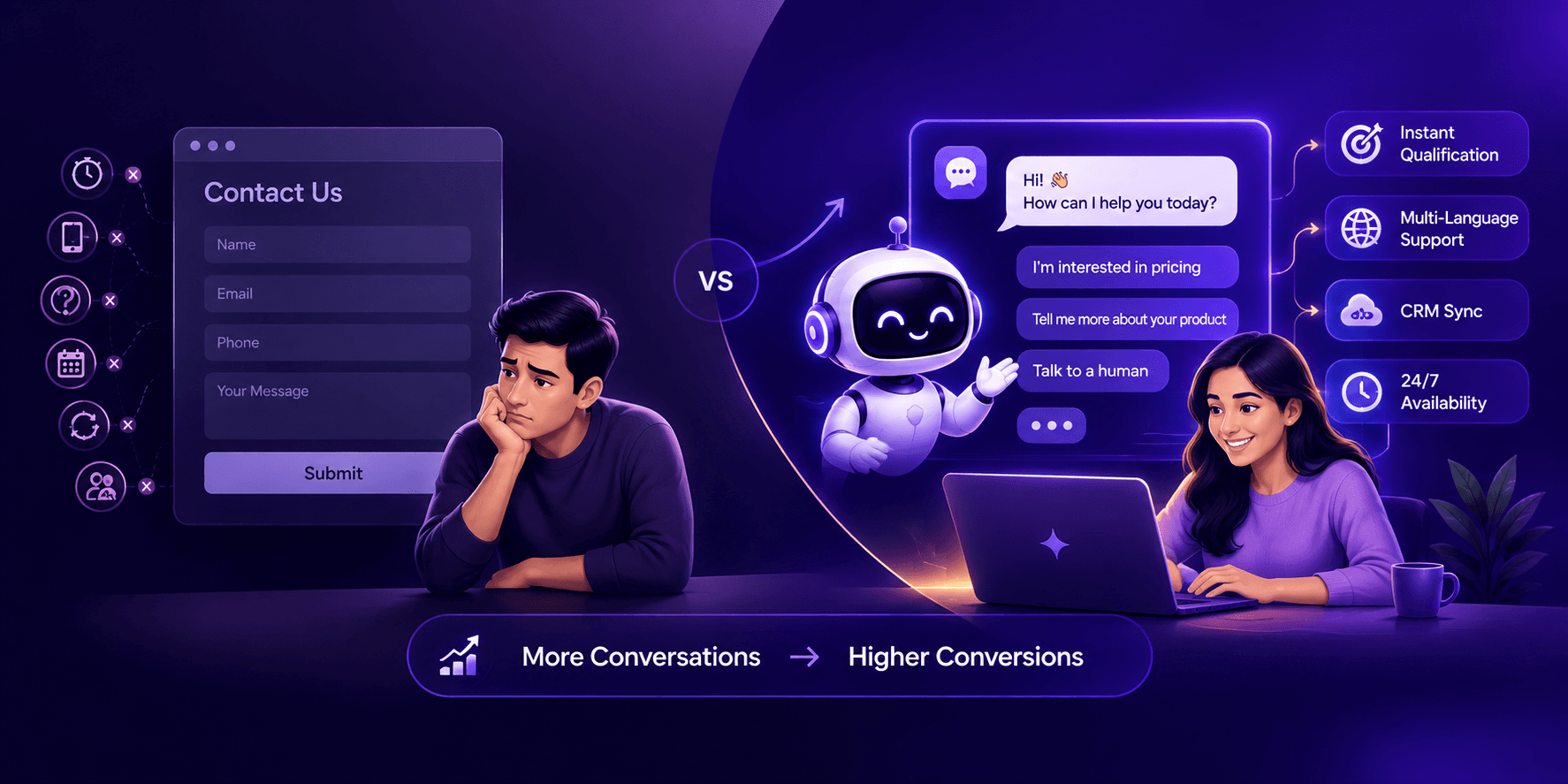
For a business, the strongest argument for restraint is the effect it has on lead capture. Form completion data makes the pattern visible. Conversion falls from around 23 percent for a form with three fields to under 7 percent once a form asks for ten or more. Each additional field is another demand made at once, with nothing returned.
An AI based chatbot collects the same information without the same weight, because it spreads the questions across a conversation and acknowledges each answer as it goes. Chatbots built this way convert website visitors into leads at 10 to 25 percent, compared with 1 to 3 percent for a typical contact form on the same page. Part of that gap comes from the principle in this article: asking for less, at a time, in a way that feels like a conversation.
| Approach | Typical conversion |
|---|---|
| Form with three fields | Around 23% |
| Form with ten or more fields | Under 7% |
| Typical website contact form | 1 to 3% of visitors |
| AI based chatbot asking one question per turn | 10 to 25% of visitors |
How MagicFlow AI applies this
MagicFlow AI is built around this approach. Because it is an AI based chatbot grounded in a knowledge base drawn from a business's own website and documents, it can retrieve the single relevant answer to a visitor's question instead of dumping everything it knows. It opens with a direct, short greeting, asks qualifying questions one at a time, and carries the campaign context (UTM source, medium and landing page) from the first message, so the conversation can begin from what the visitor already came for rather than from a blank page.
The result is a conversation that feels light for the visitor and productive for the business, which is the real purpose of saying less.
The takeaway
The temptation in chatbot design is to show how much the system knows. The discipline is to show how well it listens. The best AI chatbots behave like the best drawings: they leave space, they choose what to include, and they trust the visitor to take it from there.
If your chatbot is talking more than your visitors are, it is probably saying too much.
- Gnewuch, U., Morana, S., Adam, M., and Maedche, A., Faster is Not Always Better: Understanding the Effect of Dynamic Response Delays in Human-Chatbot Interaction, ECIS 2018 https://aisel.aisnet.org/ecis2018_rp/113/
- O'Reilly Media, Hick's Law, Laws of UX https://oreilly.com/library/view/laws-of-ux/9781098146955/ch04.html
- arXiv, When AI Becomes Hard to Understand: Cognitive Demands in Real-World Human-AI Conversations https://arxiv.org/pdf/2609.17301
- Contentsquare, The average time spent on websites: 3 tips, citing Dr Gloria Mark's attention span research https://contentsquare.com/blog/average-time-spent-on-websites-is-dropping/
- Huang, S., Lin, Y., He, Z., Huang, C., and Huang, T., How Does Conversation Length Impact User's Satisfaction? A Case Study of Length-Controlled Conversations with LLM-Powered Chatbots, CHI EA 2024 https://arxiv.org/pdf/2404.17025
- Qualtrics, 2026 Consumer Experience Trends Report, as summarised in Wonderchat, The B2B Website Conversion Benchmark Report 2026 https://wonderchat.io/blog/b2b-website-conversion-report-2026
- arXiv, Dialoging Resonance: How Users Perceive, Reciprocate and React to Chatbot's Self-Disclosure in Conversational Recommendations https://arxiv.org/pdf/2106.01666
- Digital Applied, Form Conversion Rate Benchmarks 2026: 100+ Data Points https://www.digitalapplied.com/blog/form-conversion-rate-benchmarks-2026-data-points
- Conferbot, Chatbot vs Forms: Which Gets More Leads? 2026 https://www.conferbot.com/blog/chatbot-vs-forms
- SplitForms, Contact Form Conversion Rate: Benchmarks and 12 Fixes https://splitforms.com/blog/contact-form-conversion-rate
Common questions from this article.

Head of Digital Marketing, MagicWorks IT Solutions
Purva Desai is the Head of Digital Marketing at MagicWorks IT Solutions, bringing 16 years of experience across visual arts and digital strategy. A trained artist with a Master's in Visual Art and a background in art therapy, she began her career as a graphic designer, later working as an Art Director before moving into performance marketing, SEO, and brand strategy. This dual foundation, art and analytics, shapes how she approaches marketing: understanding not just what drives clicks, but what drives human perception and emotion. She now leads MagicWorks' digital marketing department, writing on AI, buyer psychology, and the evolving intersection of creativity and data in marketing.