The silent failure of the contact form
A contact form asks a visitor to do something strange when you think about it plainly. It asks a stranger, someone who has spent perhaps 40 to 90 seconds on your site, to hand over their name, email, phone number, and often a description of their need, before they have received anything back in return.
The data on what actually happens next is stark. Roughly 81 percent of people abandon a form after they have already started filling it in. Only about 38 percent of users who begin interacting with a contact form go on to successfully submit it. And field count matters more than most businesses assume: conversion falls from around 23 percent at three fields to under 7 percent once a form asks for ten or more.
None of this is a design failure in the traditional sense. Most of these forms are clean, mobile responsive, and grammatically correct. The failure is behavioural. A form is a one way transaction with no feedback loop, and human beings are wired to distrust exactly that kind of exchange.
For every 100 people interested enough to visit your site, 97 to 99 leave without giving you any way to follow up.
Why human behaviour doesn't trust a blank form
There are three behavioural patterns at work every time a visitor hovers over a contact form and then closes the tab.
1. Ambiguity aversion
Behavioural economists have long shown that people prefer a known, if smaller, outcome over an unknown one, even when the unknown outcome might be better. A blank form is pure ambiguity. The visitor does not know who reads the message, how long a reply will take, or whether their query will even be understood. There is no signal coming back, so the brain treats the entire exchange as a risk rather than a step forward.
2. The absence of reciprocity
Robert Cialdini's principle of reciprocity, one of the most replicated findings in social psychology, shows that people are far more willing to give something once they have received something first. A form gives nothing before it asks for everything. An AI based chatbot, by contrast, opens by offering value first, answering a question, clarifying a doubt, acknowledging what the visitor is looking for, before it ever asks for a name or number.
3. Effort without feedback
Forms require the visitor to do all the cognitive work of translating their need into the exact fields a business decided to ask for. There is no acknowledgement along the way. Every field filled in feels like a small commitment made into a void, and the human mind resists committing effort when it cannot see a response to that effort in real time.
What changes when it's a conversation, not a form
The moment a visitor is greeted by a message instead of a form field, several things shift at once.
Researchers studying human interaction with conversational agents have consistently found that people extend the same social instincts to software that they extend to other people, a phenomenon documented as far back as the Computers Are Social Actors framework and confirmed again in newer studies on chatbot self-disclosure. When a chatbot opens a conversation by sharing something first, whether that is a helpful answer or a simple acknowledgement of the visitor's situation, people reciprocate by disclosing more about their own need, and they do so more willingly than they would with an anonymous form.
This is not a minor psychological footnote. Recent research on anthropomorphic conversational agents found that when a chatbot engages in what researchers call reciprocal self-disclosure, meaning it responds in a way that feels attentive rather than scripted, user trust rises measurably, and so does the depth of what the user is willing to share.
That single behavioural mechanism, conversation invites disclosure while forms suppress it, is the real reason AI chatbots consistently outconvert forms across industries, from education at up to 15.6 percent visitor to lead conversion, to financial services at around 7.8 percent.
Why this only works with an AI-based chatbot, not a scripted one
Here is the part most businesses get wrong when they first try to close this trust gap.
A rule based or script based chatbot, the kind that only follows a fixed decision tree and breaks the moment a visitor phrases a question differently than expected, does not earn trust. It erodes it. Industry research on chatbot failure has found that when an automated system cannot understand a query and defaults to a generic, repeated response, visitors bounce faster than if there had been no chatbot at all.
An AI based chatbot, one built on a language model that can actually understand intent, hold context across a conversation, and draw answers from real information about your business rather than a fixed script, behaves completely differently. It can understand a question asked in ten different phrasings and still respond correctly, remember what the visitor said two messages ago and build on it, answer genuinely unexpected questions by referencing real content from your website or documents instead of failing silently, and adjust its tone and pacing to what the visitor is actually asking for.
This distinction, AI based versus script based, is the entire difference between a chatbot that behaves the way a trustworthy system should, responsive and low friction and contextually aware, and one that behaves like the blank form it was meant to replace.
The data: AI chatbots vs contact forms
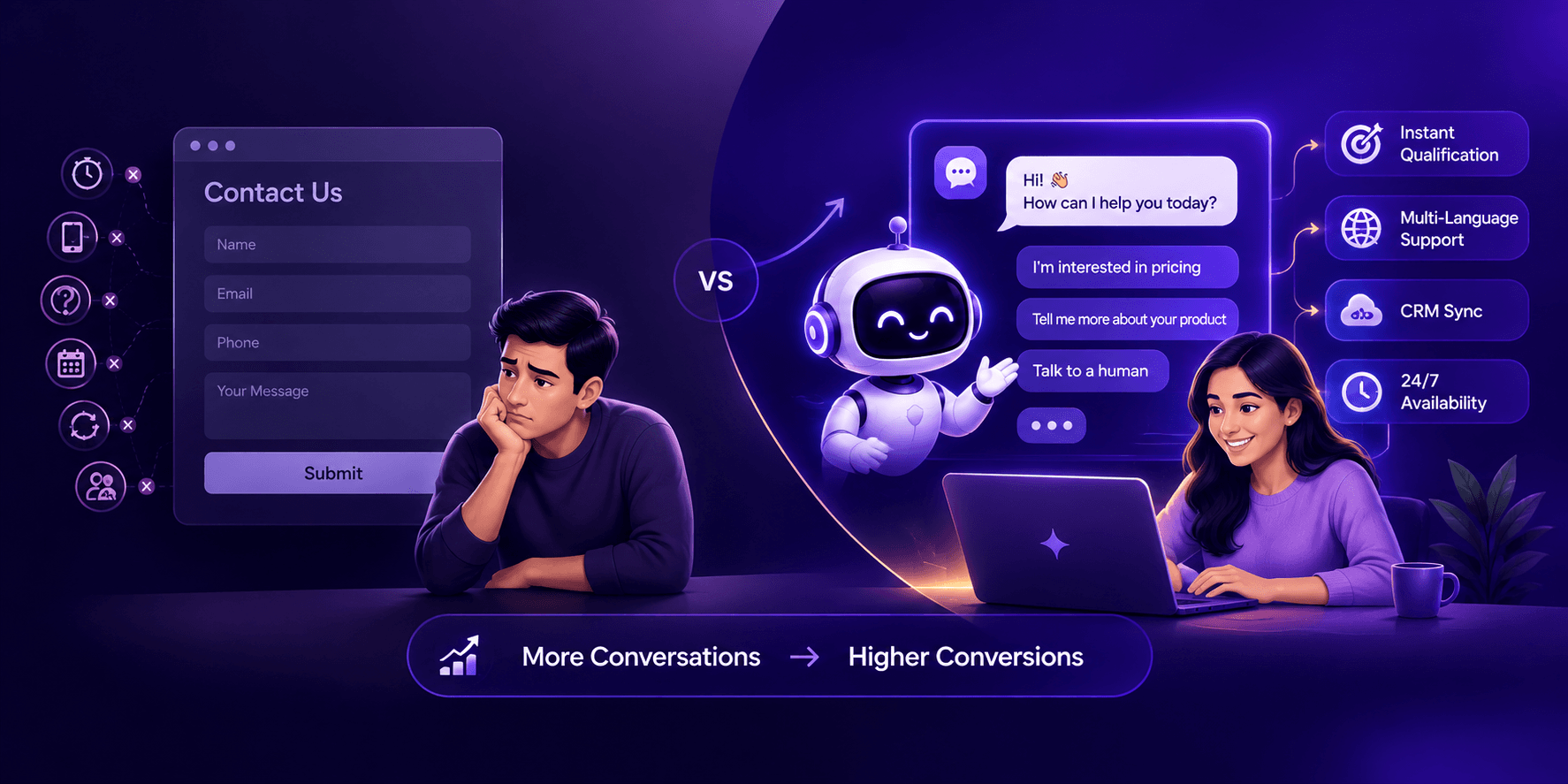
Set the two side by side and the gap is not a matter of polish. It runs through every stage of the interaction.
| Metric | Contact form | AI based chatbot |
|---|---|---|
| Typical visitor to lead conversion | 1 to 3 percent | 10 to 25 percent |
| Abandonment after starting | 81 percent abandon | Meaningfully lower, since replies happen in real time |
| Completion among those who interact | 38 percent | Conversation continues as long as the AI keeps answering usefully |
| Mobile performance | 30 to 40 percent lower completion than desktop | Native to how people already message on mobile |
| Lift from proactive engagement | Not applicable, forms are static | Up to 40 percent higher conversion with a proactive greeting |
How MagicFlow AI applies this
MagicFlow AI, built by MagicWorks IT Solutions for Indian SMEs and agencies, is designed around this exact behavioural insight. Instead of a static form, it greets every visitor with a genuine, AI led conversation, asks the qualifying questions a salesperson would ask, and captures the enquiry with full campaign context, UTM source, medium and landing page, attached automatically.
Because it is grounded in a retrieval based knowledge system built from your actual website and documents, it does not guess at answers the way a scripted bot would. It answers from what your business has actually published, which is the same trust mechanism described above: give something real first, and the visitor gives their details in return.
The takeaway
Visitors are not choosing chatbots over forms because chat is a trend. They are responding to a basic behavioural pattern: conversation feels safe because it gives something back, while a blank form asks for trust it has not yet earned.
An AI based chatbot, one that genuinely understands and responds rather than scripting a rigid path, is what makes that trust exchange possible at scale, every hour of every day, for every visitor who lands on your site.
If your forms are converting below 3 percent and your traffic is not the problem, the form probably is.
- Zuko Analytics, 25 Conversion Rate Statistics You Need in 2025 https://www.zuko.io/blog/25-conversion-rate-statistics-you-need
- SplitForms, Contact Form Conversion Rate: Benchmarks and 12 Fixes https://splitforms.com/blog/contact-form-conversion-rate
- Wonderchat, The B2B Website Conversion Benchmark Report 2026 https://wonderchat.io/blog/b2b-website-conversion-report-2026
- Conferbot, Chatbot vs Forms: Which Gets More Leads? 2026 https://www.conferbot.com/blog/chatbot-vs-forms
- Umbrex, Average Time on Website Page Analysis https://umbrex.com/resources/ultimate-guide-to-company-analysis/ultimate-guide-to-marketing-analysis/average-time-on-website-page-analysis/
- Numen Technology, Contact Form Optimization: Fix 81% Abandonment Rate https://www.numentechnology.co.uk/blog/contact-form-optimization-conversion-rates
- Digital Applied, Form Conversion Rate Benchmarks 2026: 100+ Data Points https://www.digitalapplied.com/blog/form-conversion-rate-benchmarks-2026-data-points
- Springer Nature, Self-disclosure to conversational AI: a literature review, emergent framework, and directions for future research https://link.springer.com/article/10.1007/s00779-024-01823-7
- PNAS, The benefits and dangers of anthropomorphic conversational agents https://www.pnas.org/doi/10.1073/pnas.2415898122
- arXiv, Dialoging Resonance: How Users Perceive, Reciprocate and React to Chatbot's Self-Disclosure in Conversational Recommendations https://arxiv.org/pdf/2106.01666
- Collabra: Psychology (UC Press), The Effects of AI Anthropomorphism on Trust and Responsibility https://online.ucpress.edu/collabra/article/12/1/161757/218332
- Count, Form Conversion Rate: Calculate, Benchmark & Improve https://count.co/metric/form-conversion-rate
- Which-50, Chat-to-Conversion Rate Statistics By Industry https://which-50.com/chat-to-conversion-rate-statistics-by-industry/
Common questions from this article.

Head of Digital Marketing, MagicWorks IT Solutions
Purva Desai is the Head of Digital Marketing at MagicWorks IT Solutions, bringing 16 years of experience across visual arts and digital strategy. A trained artist with a Master's in Visual Art and a background in art therapy, she began her career as a graphic designer, later working as an Art Director before moving into performance marketing, SEO, and brand strategy. This dual foundation, art and analytics, shapes how she approaches marketing: understanding not just what drives clicks, but what drives human perception and emotion. She now leads MagicWorks' digital marketing department, writing on AI, buyer psychology, and the evolving intersection of creativity and data in marketing.