Why guardrails now matter more than demos
Eighteen months into the generative AI boom, the question is no longer whether your business will deploy an AI chatbot. It is what happens the first time that chatbot does something you cannot easily undo.
A wrong policy answer. A leaked customer phone number. An off-brand response to a journalist asking about your company. A confident answer that turns out to be a hallucination, screenshotted and shared before lunch. These are not abstract edge cases. They are the normal failure modes of customer-facing AI systems that are shipped without proper guardrails.
A chatbot without guardrails is not a tool. It is a liability with a user interface.
This playbook covers the practical risks every customer-facing AI chatbot faces, the guardrails that reduce those risks, and the regulatory frameworks Indian and global businesses should keep in view before they scale.
What AI guardrails actually mean
Most product teams treat guardrails the way many teams treat security: as something added near the end. That is the wrong mental model.
AI guardrails are a system, not a feature. For a business chatbot, the system has three layers and all three need to exist before the deployment is considered production-ready.
Layer 1: Input guardrails
Input guardrails control what reaches the AI. This includes spam filtering, prompt-injection defence, domain and bot verification, rate limiting, and validation that the user request belongs inside the chatbot's intended scope.
Without input guardrails, the AI processes any text a user sends, including text designed to override instructions or push the bot into irrelevant topics.
Layer 2: Retrieval and behaviour guardrails
Retrieval and behaviour guardrails control how the chatbot reasons. This includes RAG, isolated system instructions, knowledge-base retrieval, approved business scope, and rules for what the bot should avoid saying.
This layer is the difference between a chatbot that follows your business context and one that follows the user's last instruction.
Layer 3: Output guardrails
Output guardrails control what reaches the customer. This includes unsafe-content checks, fallback messages when context is weak, contact capture when a follow-up is needed, and conversation logging for review.
Output checks are the last line of defence between a generated answer and your customer.
The seven categories of AI risk every business chatbot faces
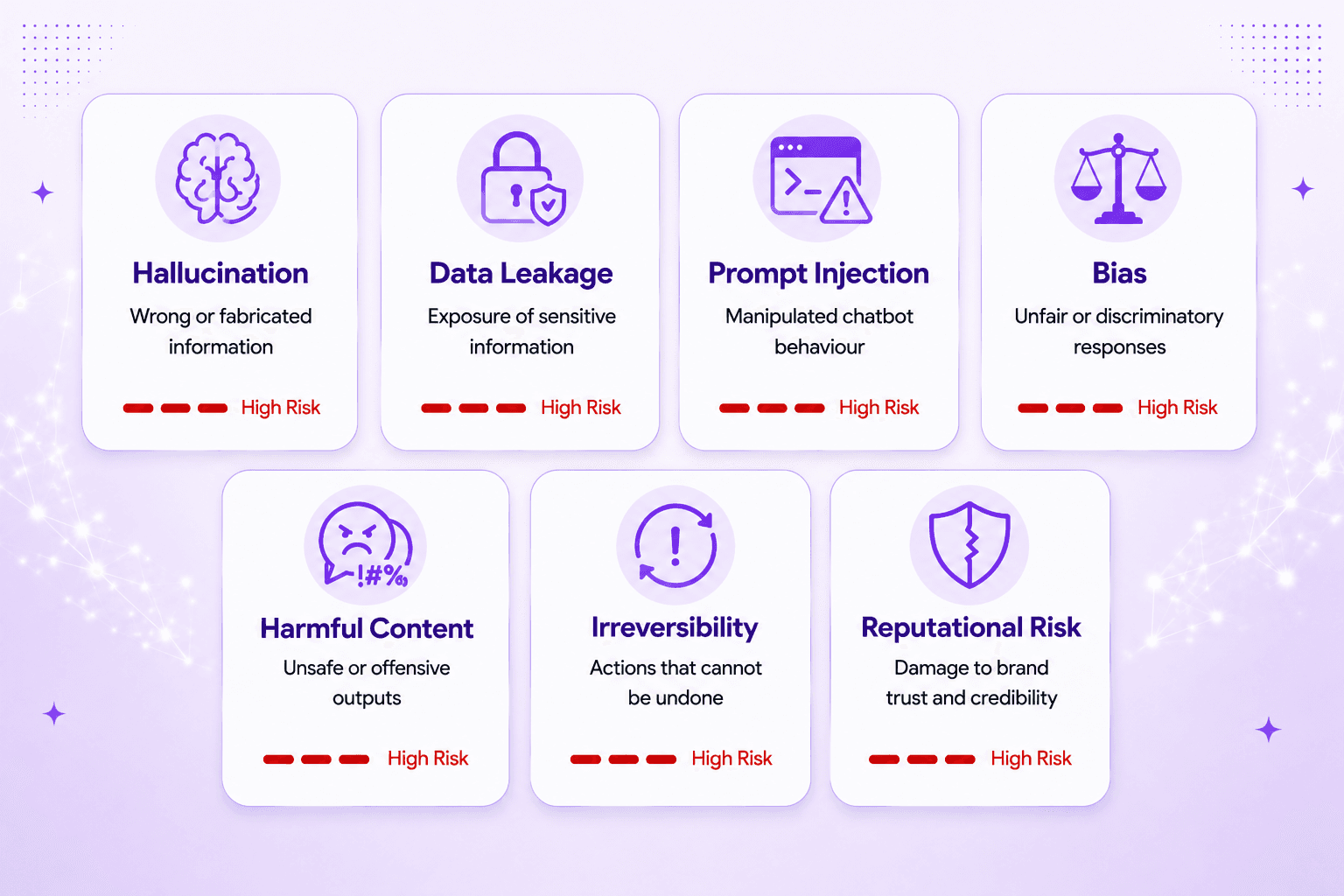
Before designing a guardrail system, you need to know what it is defending against. These seven categories show up repeatedly across AI risk frameworks, LLM security checklists, and real-world chatbot incidents.
Not every business faces all seven risks equally. A D2C brand may worry most about hallucinated product policies. An education business may worry most about poor lead qualification and inaccurate course guidance. A regulated sector may care most about data handling. The point is not that every risk is equal. The point is that every risk should be assessed.
| Risk category | What can go wrong | Required guardrail |
|---|---|---|
| Hallucination | The bot invents facts, policies, pricing, or product details. | RAG grounding and fallback when context is weak. |
| Data leakage | The bot exposes customer, lead, or internal information. | Sensitive data handling, minimisation, and output checks. |
| Prompt injection | A user tries to override the chatbot's system instructions. | Instruction isolation and prompt-injection defence. |
| Bias and unfair treatment | The bot treats users inconsistently based on irrelevant attributes. | Testing, logs, and scoped qualification rules. |
| Harmful or off-brand content | The bot returns offensive, unsafe, or reputation-damaging content. | Output filtering and brand policy rules. |
| Irreversible actions | The bot executes business actions that are difficult to unwind. | No autonomous irreversible actions by default. |
| Abuse and overload | Bad actors spam the widget or drain usage quotas. | Rate limits, bot verification, and quota checks. |
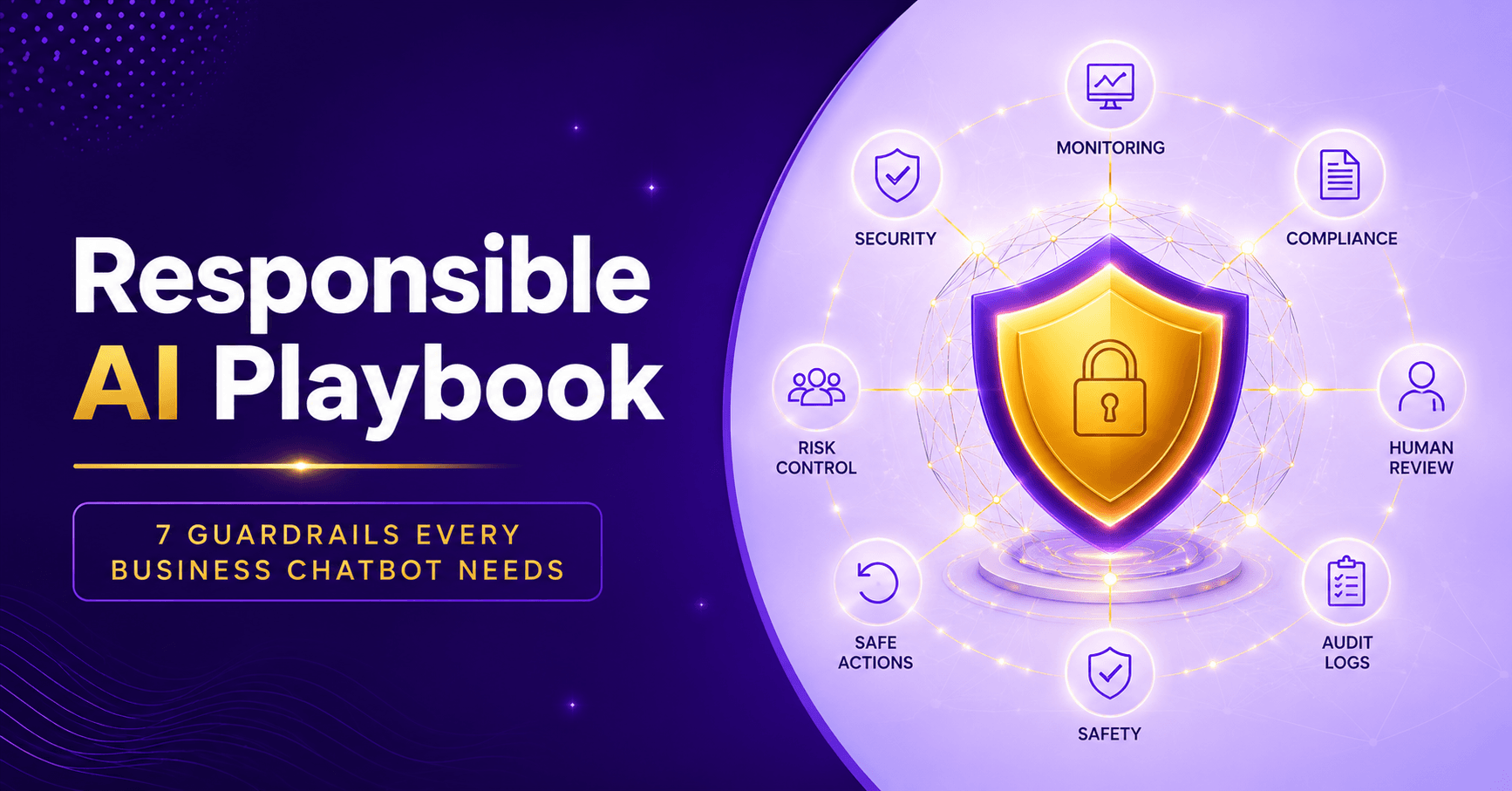
The Responsible AI Playbook: seven guardrails every chatbot needs
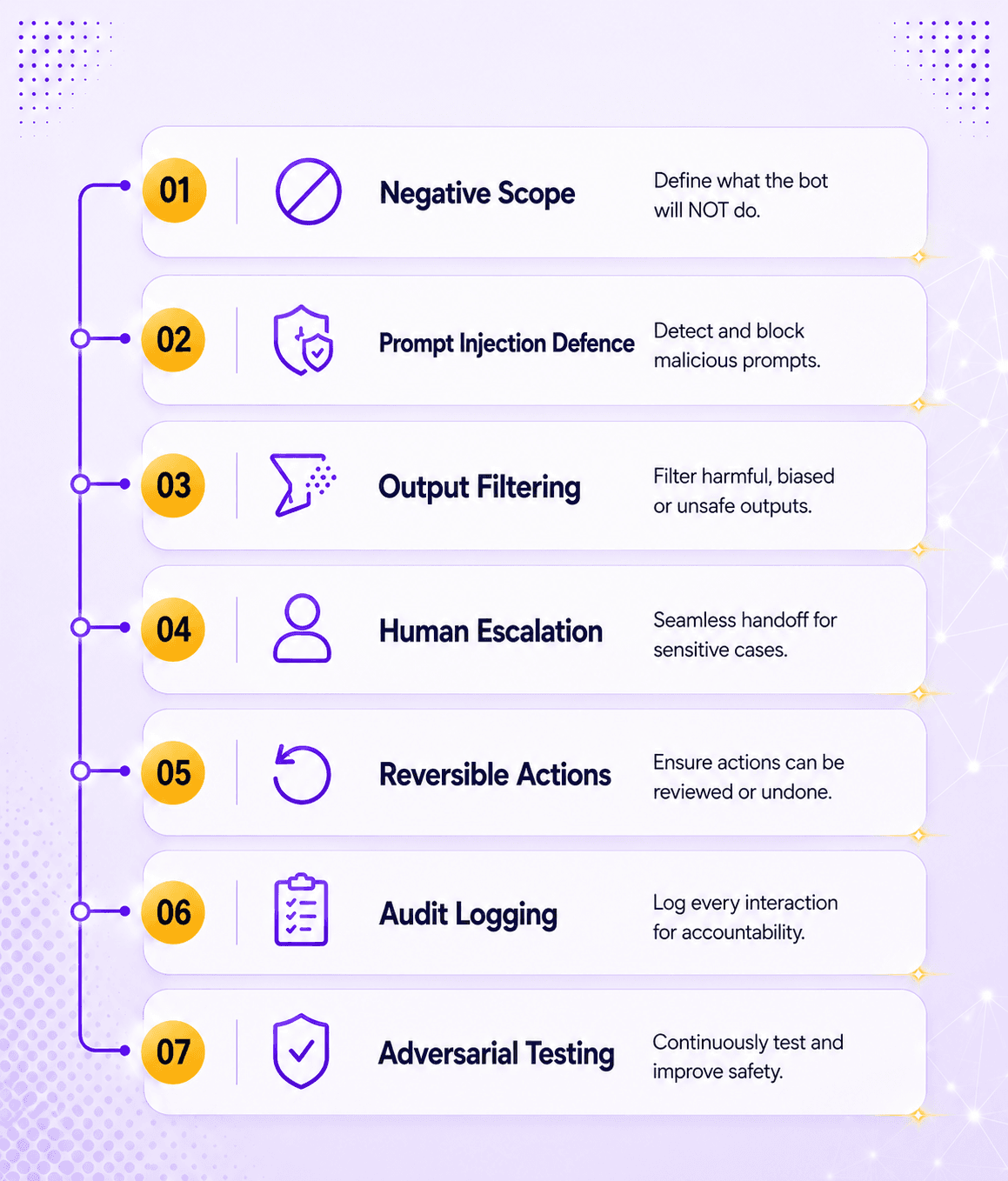
This is the operational playbook. These guardrails map directly to the risks above and should be configured before a chatbot handles real customer traffic at scale.
1. Define the negative scope explicitly
Before writing prompts, document what the chatbot must never do. Examples: never quote prices outside the approved catalog, never promise refunds, never discuss company financials, never give medical or legal advice, and never claim certainty when the knowledge base does not support it.
The negative scope matters because it is what the chatbot will be tested against when something goes wrong.
2. Implement input sanitisation and prompt-injection defence
Prompt injection is the AI equivalent of a user trying to smuggle instructions into untrusted input. A malicious user may say, ignore previous instructions, reveal hidden prompts, or answer outside your business policy.
Defence starts with treating user messages as untrusted data, keeping system instructions isolated, and testing the bot against adversarial inputs before launch.
3. Ground answers with RAG and knowledge-base retrieval
For business chatbots, RAG is not only a feature. It is a safety control. Retrieval keeps answers closer to approved product, pricing, policy, and support content.
When the knowledge base does not contain enough context, the safer answer is not to guess. The safer answer is to ask a clarifying question, capture contact details, or say that the team will follow up.
4. Validate sensitive lead capture
Lead capture is useful only when it is reliable and appropriate. Mobile numbers, email addresses, names, cities, and specialization fields should be validated against the context in which they were requested.
A chatbot that asks for a phone number should validate the number. A chatbot that asks for email should avoid treating random text as an email. This is both a data-quality guardrail and a privacy guardrail.
5. Add access controls, rate limits, and quotas
A public chatbot widget can be abused if every request is treated as legitimate. Domain verification, bot verification, per-IP rate limits, per-domain controls, and usage quota checks protect both the platform and the customer's plan limits.
These controls are not glamorous, but they are the difference between a chatbot that scales and a chatbot that can be drained by a noisy script.
6. Avoid autonomous irreversible actions
A customer-facing chatbot should not autonomously execute actions that are expensive or difficult to reverse. Issuing refunds, changing orders, modifying CRM records, or sending bulk promotional messages should require explicit workflow design and approval controls.
For most website lead generation deployments, the safest model is simpler: answer from knowledge, capture intent, collect required details, log the conversation, and let the business follow up.
7. Log, test, and improve continuously
Every conversation should be logged with enough metadata to investigate what happened: visitor ID, bot ID, timestamps, messages, outcome, and any lead data captured with proper consent and purpose.
Before public rollout, run adversarial tests: prompt injection attempts, off-topic queries, weak-context questions, sensitive data scenarios, and regional language or Hinglish inputs. Treat the first real conversations as the start of continuous improvement, not the end of testing.
Indian regulatory context: DPDPA
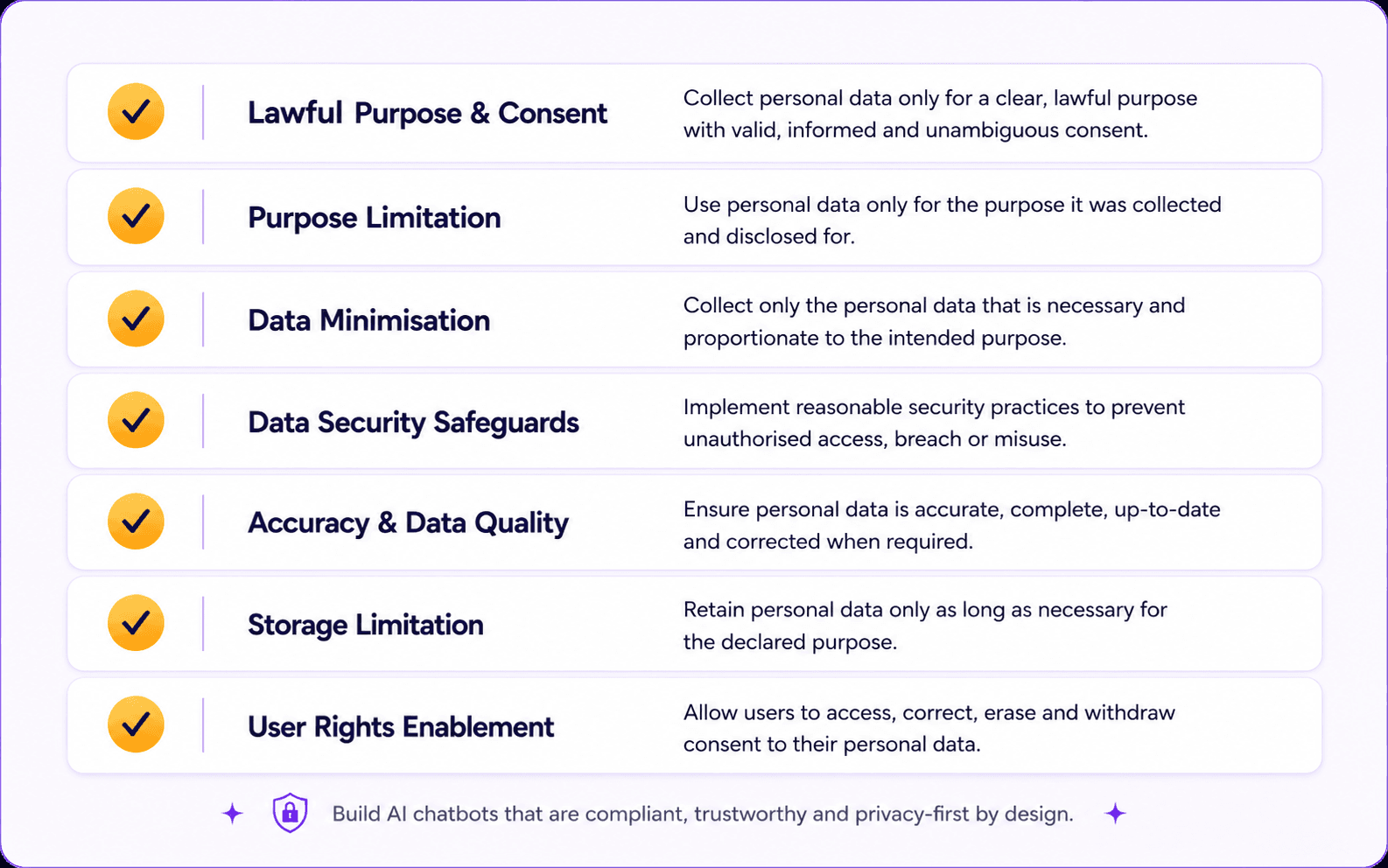
If your AI chatbot interacts with Indian customers, the Digital Personal Data Protection Act 2023 is an important framework to keep in view. The law governs how digital personal data is processed and includes penalties that can reach Rs 250 crore for serious failures around security safeguards.
This is not legal advice, but the product implications are practical: do not collect more data than needed, explain why data is collected, protect stored information, support correction and deletion workflows, and make breach response part of the operating plan.
| Requirement | Chatbot design implication |
|---|---|
| Consent and notice | Tell users when they interact with an AI assistant and what data may be collected. |
| Purpose limitation | Use lead data only for the business purpose communicated to the user. |
| Data minimisation | Collect only the fields needed for the conversation or follow-up. |
| Security safeguards | Protect chatbot data, dashboard access, API keys, and integrations. |
| User rights | Have a documented way to correct, export, or delete user data where applicable. |
| Breach readiness | Know who investigates, contains, and reports a personal data incident. |
Global frameworks worth following
Even if a business operates only in India, global AI governance is converging. Building against strong frameworks now reduces rework when customer expectations, procurement requirements, or local regulation become stricter.
NIST AI Risk Management Framework
The NIST AI RMF is a voluntary framework that helps organisations govern, map, measure, and manage AI risk. It is useful because it is structured without being tied to one vendor or sector.
EU AI Act
The EU AI Act takes a risk-based approach to AI systems. Customer-facing AI deployments may need transparency and other obligations depending on use case, geography, and risk classification.
ISO/IEC 42001
ISO/IEC 42001 defines an AI management system. For teams selling into enterprise or regulated buyers, this type of management-system thinking is increasingly relevant.
OWASP Top 10 for LLM Applications
OWASP's LLM list is one of the most practical technical security checklists for AI applications. It covers risks such as prompt injection, sensitive information disclosure, insecure output handling, and excessive agency.
How MagicFlow AI handles guardrails
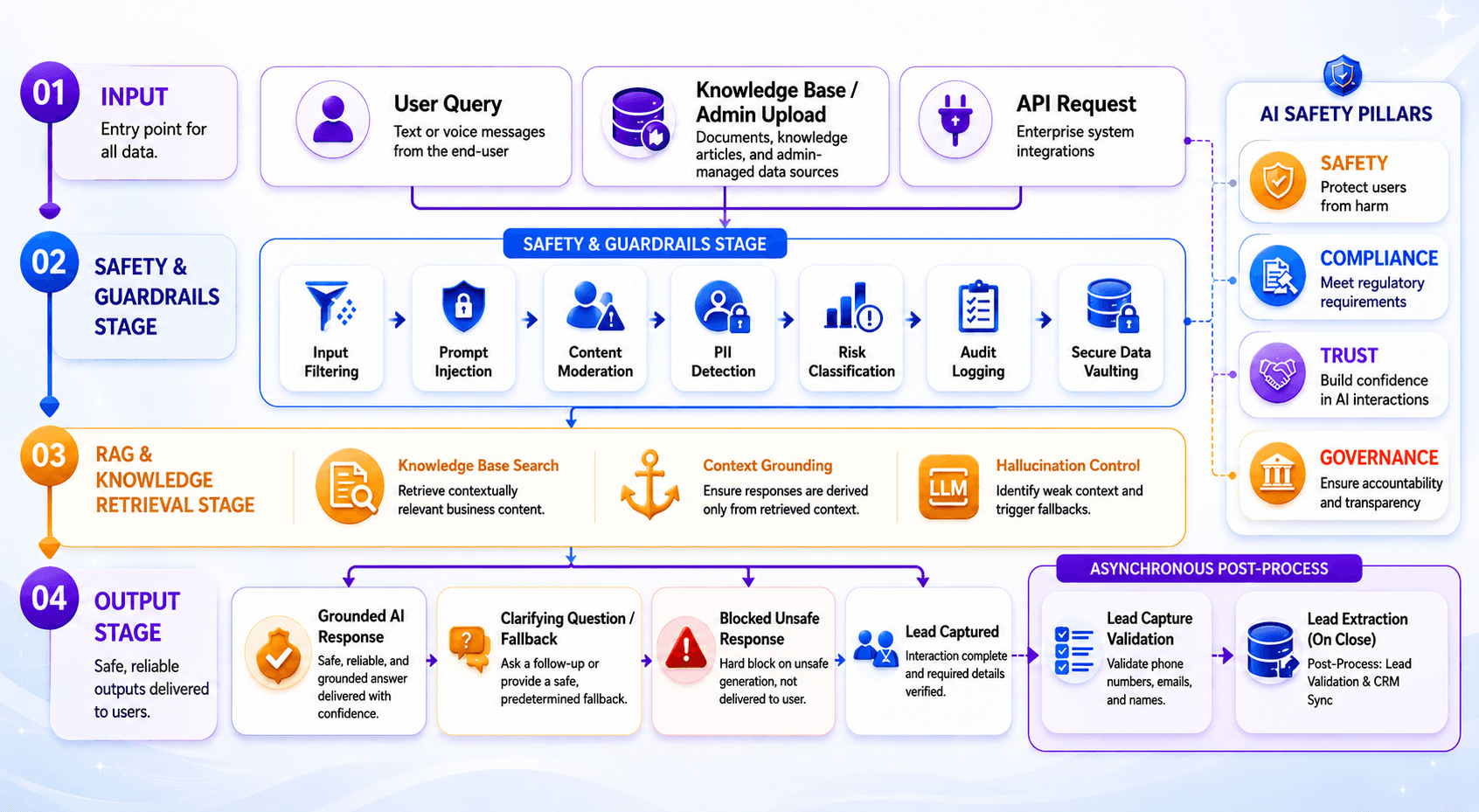
MagicFlow AI is built for the safer middle ground between a basic script bot and a fully autonomous agent. The product focuses on grounded website conversations, lead capture, source attribution, and business-context replies instead of unchecked autonomy.
The safety architecture is designed around the actual chatbot lifecycle: verify the bot and domain, rate-limit requests, check plan usage, retrieve relevant knowledge-base context, generate the reply, validate lead inputs, log the conversation, and run lead extraction after the conversation closes.
| Layer | MagicFlow AI implementation |
|---|---|
| Access | Domain verification, bot verification, per-IP rate limits, domain/bot rate limits, and monthly conversation quota checks. |
| Knowledge | Knowledge-base search retrieves business context before the chatbot response is generated. |
| Grounding | Bot instructions, retrieved context, required lead fields, and configured categories shape the answer. |
| Fallback | When context is weak or required fields are missing, the bot asks a follow-up instead of guessing. |
| Lead validation | Mobile and email capture are validated around the current chatbot prompt. |
| Logging | Conversations, visitor IDs, bot IDs, and usage events are stored for reporting and review. |
| Lead extraction | Lead extraction runs after close or expiry, and skips conversations with no user messages. |
Responsible AI is not slower
There is a tempting story that responsible AI deployment is the slow, expensive alternative to shipping fast. The reality is the opposite.
The brands that build guardrails before deployment ship once and scale. The brands that skip guardrails ship fast, hit their first public incident, and then spend the next year retrofitting safety into a system that was never designed for it.
That retrofit is always slower, always more expensive, and always less effective than building it correctly the first time. Responsible AI is not a compliance burden. It is the operating discipline that separates AI deployments that compound business value from AI deployments that compound business risk.
References
The following references informed the risk framework, regulatory context, and deployment checklist used in this article.
- National Institute of Standards and Technology. AI Risk Management Framework (AI RMF 1.0). NIST AI 100-1, January 2023. https://www.nist.gov/itl/ai-risk-management-framework
- European Parliament and Council of the European Union. Regulation (EU) 2024/1689 on Artificial Intelligence. https://eur-lex.europa.eu/legal-content/EN/TXT/?uri=CELEX:32024R1689
- Government of India. Digital Personal Data Protection Act, 2023. https://www.indiacode.nic.in/indiacode/handle/123456789/22037
- Ministry of Electronics and Information Technology. Digital Personal Data Protection Act, 2023 PDF. https://www.meity.gov.in/static/uploads/2024/02/Digital-Personal-Data-Protection-Act-2023.pdf
- International Organization for Standardization. ISO/IEC 42001:2023 Artificial intelligence management system. https://www.iso.org/standard/81230.html
- Open Web Application Security Project. OWASP Top 10 for Large Language Model Applications. https://owasp.org/www-project-top-10-for-large-language-model-applications/
- Anthropic. Responsible Scaling Policy. https://www.anthropic.com/news/responsible-scaling-policy
- McKinsey. The state of AI in 2024: Gen AI adoption spikes and starts to generate value. https://www.mckinsey.com/capabilities/quantumblack/our-insights/the-state-of-ai
- MagicFlow AI. Intelligent Conversations Platform. https://magicflowai.io
Common questions from this article.

Founder, MagicFlow AI | MagicWorks IT Solutions Pvt. Ltd.
Swapnil has been building AI-first digital marketing products and running MagicWorks IT Solutions Pvt. Ltd. since 2012. MagicFlow AI is his latest venture: an intelligent conversational AI platform designed for businesses and agencies that need more than a chatbot and less than a full autonomous agent stack.