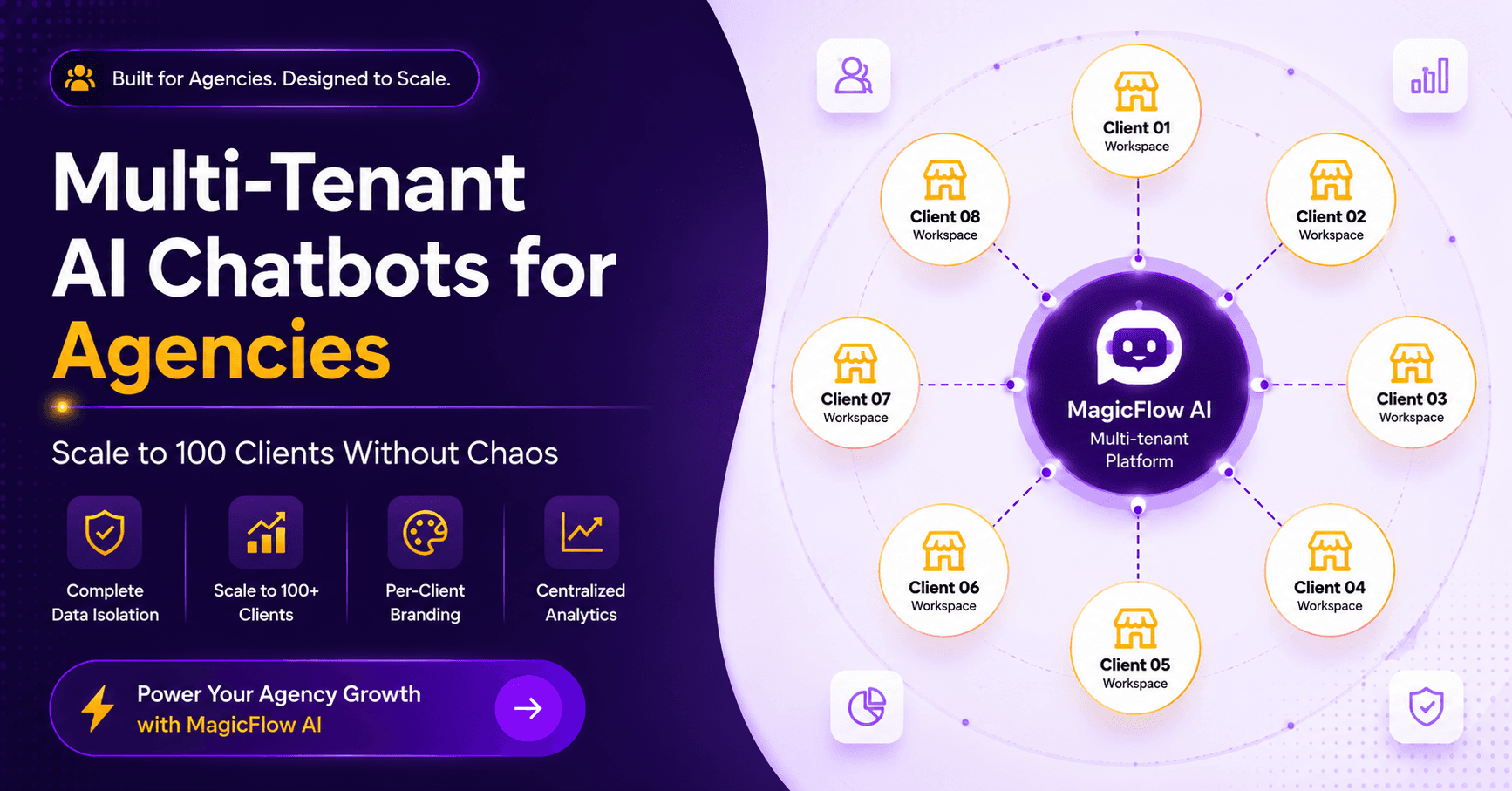
The architecture problem hiding inside agency growth
Every digital agency owner has the same conversation around client number twelve. Things stop being scrappy and start being broken. Deployments slip. Engineers complain. Margins compress. New client meetings start with apologies for the previous client's last incident.
Most agency owners assume this is the cost of growth. It is not. It is the cost of the wrong architecture, applied at scale. The agencies that grow past 20 clients without burning out their team are not working harder. They are working on top of a fundamentally different technical foundation.
That foundation has a name: multi-tenant architecture. Every modern SaaS platform you have ever used, from Slack to Notion to HubSpot to Salesforce, is built on it. The same principle, applied to AI chatbot delivery, is what separates agencies that scale from agencies that ceiling.
This blog is the architectural and economic case for multi-tenant AI chatbots, written for the agency owner, white-label reseller, or SaaS founder who wants to serve more clients with less chaos and more margin.
The five pain points every agency hits at scale
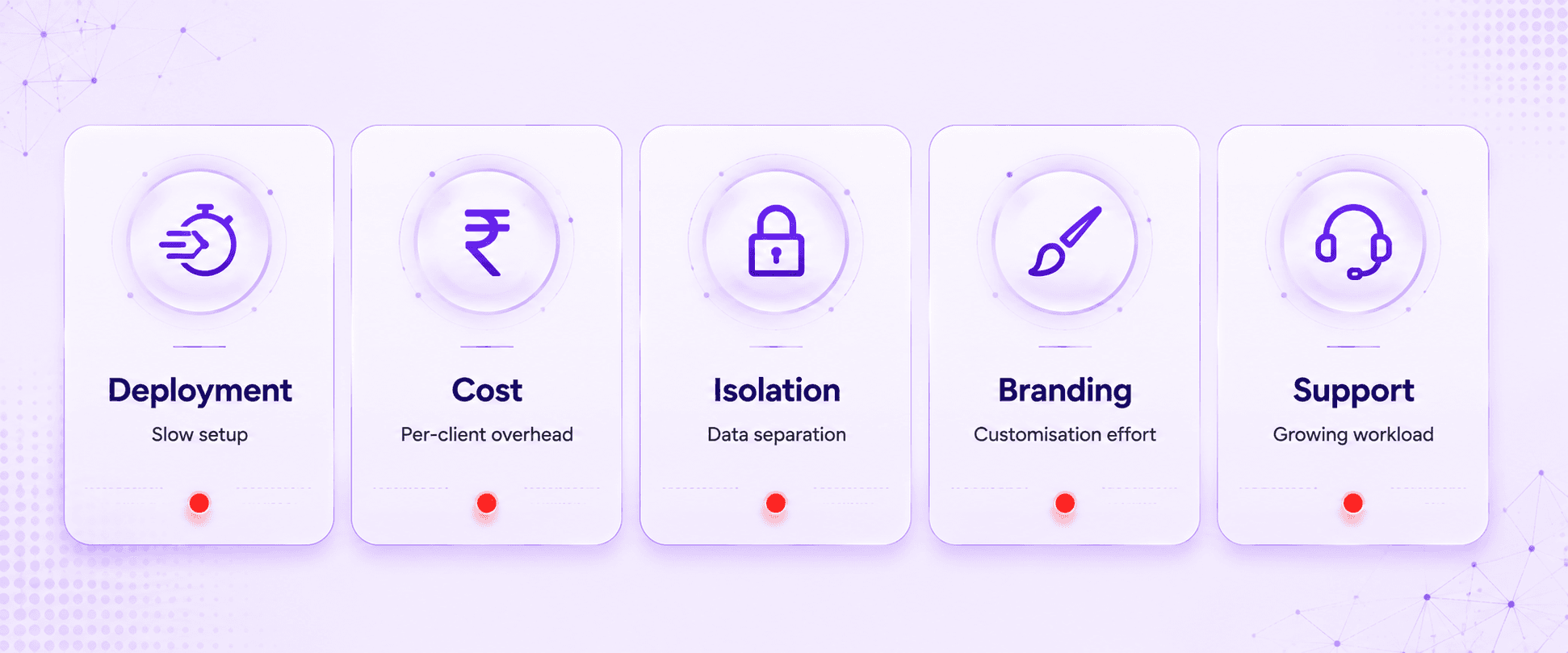
Before talking about the solution, it helps to name the pattern. These are the five operational failures that consistently appear in agencies that have outgrown single-tenant chatbot delivery.
1. Deployment time per client never drops
Client one took three weeks. Client ten still takes three weeks. Client twenty still takes three weeks. The engineering team has learned nothing reusable because each deployment was treated as a custom build. Every new client is a fresh project, not a configuration.
2. Engineering cost compounds, not amortises
In a single-tenant setup, every additional client adds proportional engineering load. By client twenty, the agency is running a small engineering team just to keep the existing deployments alive, with very little capacity for new feature work or growth.
3. Feature rollouts become impossible
A new product improvement that should take a week to deploy now takes a month: deploy to client A, test, deploy to client B, test, deploy to client C, test, and so on. The longer the client list, the slower the agency moves. Eventually new features get shelved entirely.
4. Data isolation becomes a liability risk
Each single-tenant deployment is a separate system to secure, monitor, and audit. The probability that one of them is misconfigured rises linearly with client count. The first data leak between clients is a contract-ending incident, not a bug.
5. Support costs eat the margin
Each client has their own setup, their own quirks, and their own configurations. The support team cannot generalise. Every ticket is a fresh investigation. By the time the agency is serving 30 clients, support headcount equals or exceeds engineering headcount.
Single-tenant chatbot delivery does not scale. It just gets more expensive in a different way each time you add a client.
What multi-tenant actually means
Multi-tenant is one of those terms that gets used carelessly in agency conversations. Before going further, here is the precise definition.
The architectural definition
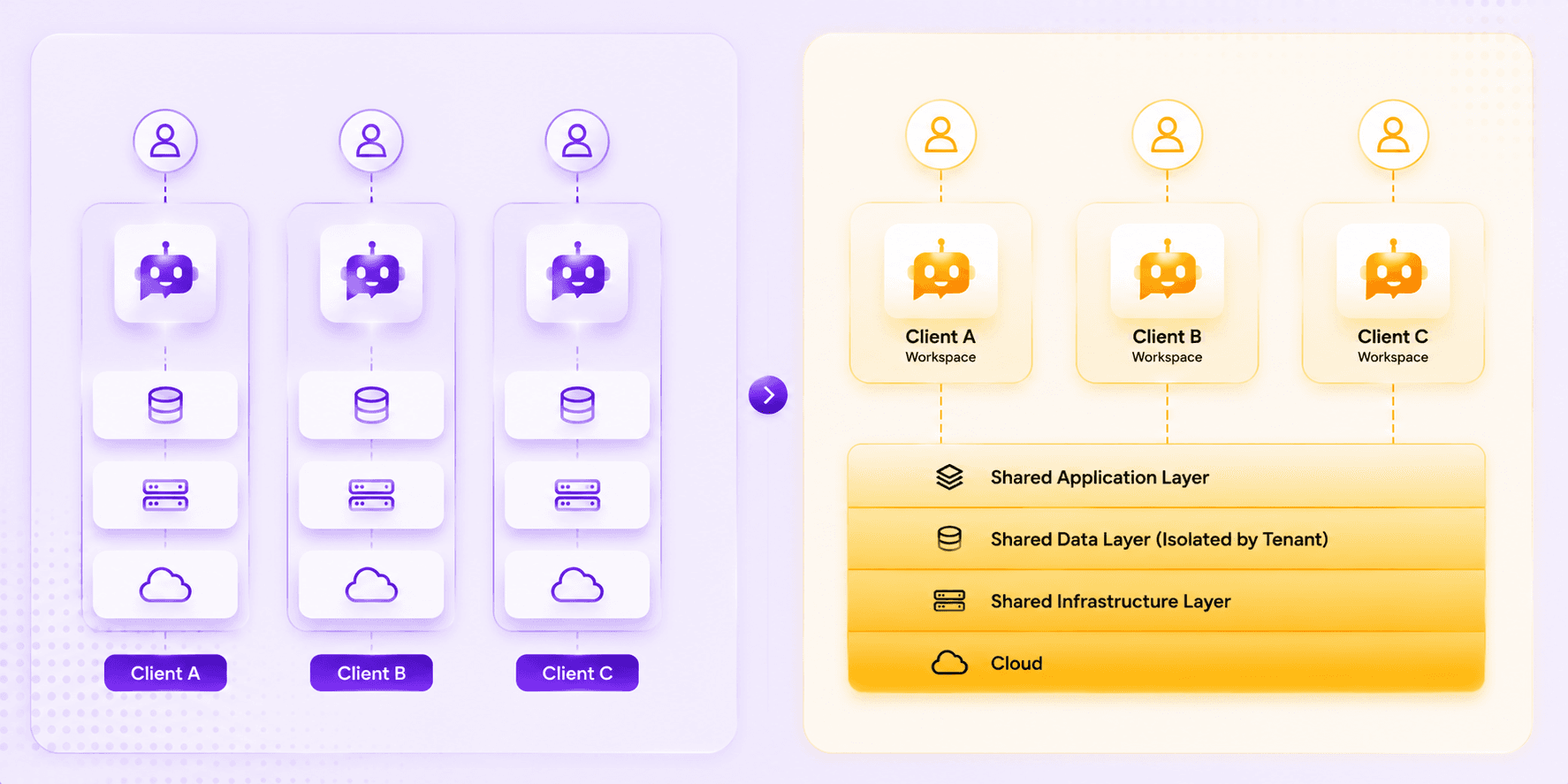
A multi-tenant system serves multiple distinct customer organisations, or tenants, from a single shared infrastructure. Each tenant's data, configuration, branding, and access are logically isolated from every other tenant. A user in tenant A cannot see, access, or affect anything in tenant B, even though both tenants are running on the same underlying platform.
Compare this to a single-tenant setup, where each client gets their own separately deployed instance of the software. Single-tenant is conceptually simple: each client is fully isolated because each client has their own dedicated stack. But that simplicity is exactly what makes it economically punishing at scale.
The agency-facing definition
From the agency's perspective, a multi-tenant AI chatbot platform looks like one workspace where the agency administrator can create a new client workspace in minutes, configure each workspace's branding and integrations independently, deploy AI features across all client workspaces with one click, view aggregated analytics across all clients, and manage billing per client with full usage accounting.
From the client's perspective, the platform looks like a fully branded, dedicated AI chatbot solution built specifically for their business. They never see other clients, never see the agency's underlying platform, and never know they are sharing infrastructure with hundreds of other businesses.
What multi-tenant is not
Multi-tenant is not the same as white-label. Multi-tenant is about how the platform is built. White-label is about how it is sold under your own brand instead of the platform vendor's brand. Most agency-ready platforms offer both, but they answer different questions.
Multi-tenant is also not the same as multi-instance. A multi-instance deployment runs separate copies of the application per client, which is single-tenant by another name. A true multi-tenant deployment shares the application layer entirely, with tenant context enforced at every database query and API call.
This matters because a lot of platforms marketed to agencies are not actually multi-tenant. They are single-tenant deployments dressed up with an admin panel. Before signing a reseller agreement, the architectural question matters: does the platform enforce tenant isolation at the database level, or does it just hide tenant data behind a UI filter?
The architectural shift, visualised
Here is the side-by-side that captures the economic story. Every dimension below is measurable, and every difference compounds as the agency adds clients.
These figures are aggregated across agency case studies and our own conversations with white-label resellers operating in India, Southeast Asia, and the Middle East. Individual agencies vary, but the directional shift is consistent: multi-tenant architecture changes the unit economics of the business, not just the technical setup.
| Dimension | Single-Tenant Setup | Multi-Tenant Architecture |
|---|---|---|
| Onboarding a new client | 2 to 4 weeks per client | 1 to 3 days per client |
| Engineering team needed | 1 dev per 5 to 10 clients | 1 dev per 50 to 100 clients |
| Cost per client served | Rs 18,000 to 25,000 per month | Rs 2,500 to 4,500 per month |
| Data isolation | Manual, error-prone | Logical, enforced by platform |
| Feature rollouts | Deploy and test per client | Deploy once, available to all |
| Brand customisation | Hard-coded per instance | Configurable per workspace |
| Billing and invoicing | Manual reconciliation | Per-tenant automated |
| Scaling to 100 clients | Unsustainable: 20 to 30 engineers needed | Sustainable: 2 to 4 engineers |
Why logical isolation can be safer than manual isolation
One dimension worth expanding on is data isolation. In a single-tenant setup, data separation is achieved by physical separation: each client is its own instance, so cross-client data access is impossible because there is no shared system. In a multi-tenant setup, data separation is achieved logically, through tenant identifiers enforced at every query level.
Done properly, multi-tenant isolation is more reliable than physical isolation, not less. The reason is automation: a multi-tenant platform applies the same isolation policy to every query, every API call, and every analytics event, without depending on engineering discipline per deployment. The same cannot be said of 50 separately maintained single-tenant deployments.
The platforms that take this seriously implement row-level security at the database, scoped authentication tokens at the application layer, and tenant-aware audit logging across every interaction. The platforms that do not, eventually leak. The difference is not visible at signup. It is visible at client number forty-five.
The economics that change everything
This is the section that decides whether your agency is a services business or a software business. The difference is not in your branding or your sales pitch. It is in your unit economics.
| Scenario | Custom Build / Single-Tenant | Multi-Tenant Reseller Model |
|---|---|---|
| Time to onboard 20 clients | 10 to 14 months | 6 to 8 weeks |
| Average revenue per client | Rs 12,000 to 25,000 per month | Rs 15,000 to 35,000 per month |
| Gross margin per client | 30 to 45 percent | 65 to 80 percent |
| Engineering and ops cost for 20 clients | Rs 1.2 to 1.8 Crore per year | Rs 25 to 45 Lakh per year |
| Client churn rate | 20 to 30 percent annually | 8 to 12 percent annually |
| Time to scale beyond 50 clients | Requires major re-architecture | Linear growth, no rebuild |
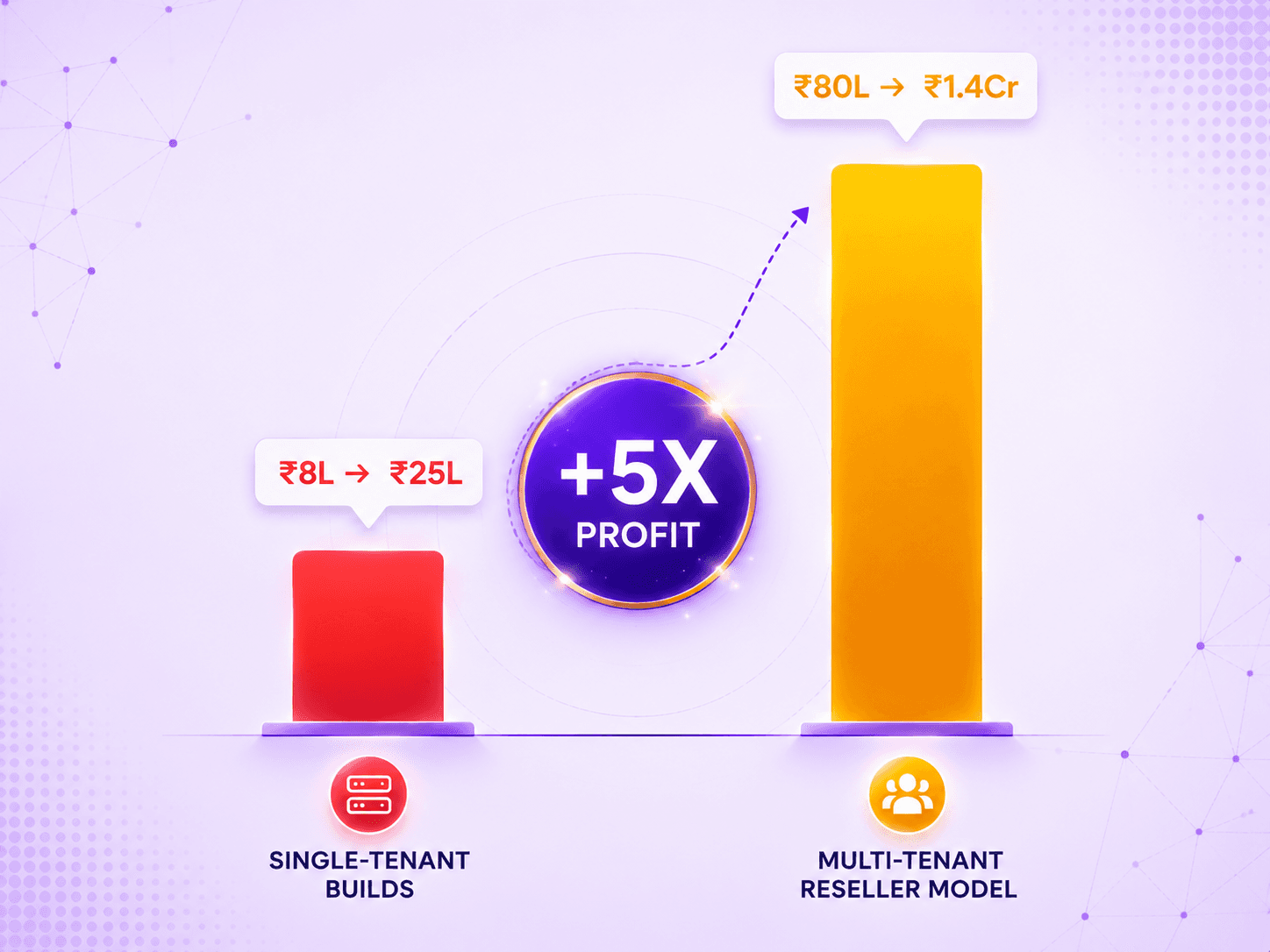
| Year-2 net profit for 20 clients | Rs 8 to 25 Lakh | Rs 80 Lakh to 1.4 Crore |
Why margins expand so dramatically
Read those rows slowly. The most important row is the last one: year-two net profit on 20 clients. The same number of clients, served on the same kind of AI deployment, produces roughly 10x the profit on multi-tenant architecture versus custom builds. The difference is not pricing. It is cost structure.
Multi-tenant agencies amortise three categories of cost across every client they add. Custom-build agencies do not. One feature is built once and deployed to all clients automatically. One support runbook covers all clients because the underlying platform is identical. Shared infrastructure lowers per-conversation API costs at volume, with savings that compound rather than just stack.
Why churn drops
Multi-tenant clients churn less for a counter-intuitive reason: the platform improves continuously, and every improvement reaches every client at the same time. Custom-build clients see their deployment age. The day-one deployment is the best version they ever get, unless the agency invests engineering time to upgrade them, which usually does not happen until they threaten to leave.
Multi-tenant clients also see the 3x conversion lift documented in the data more consistently because the platform applies optimisations across all tenants simultaneously. Higher results drive lower churn, which drives compounding annual recurring revenue for the agency.
The combined effect is that a 20-client agency on a multi-tenant platform is not just more profitable. It is structurally easier to operate, easier to scale, and easier to sell, whether to investors or as an acquisition target.
What to look for when evaluating a multi-tenant platform
Not every platform claiming multi-tenant actually is one. Before signing a reseller agreement or building your agency on top of a platform, the seven checks below separate real multi-tenant architectures from marketing claims.
Check 1: Database-level tenant isolation
Ask directly: is tenant isolation enforced at the database level using row-level security, or is it enforced at the application layer through query filters? The first is robust. The second is a data breach waiting to happen. Reputable platforms will not hesitate to answer this technically.
Check 2: Per-tenant workspace independence
Each client workspace should have independent branding, independent integrations, and independent analytics. If clients can see anything about other clients, the platform is not properly multi-tenant.
Check 3: Single-click feature rollout
A platform improvement should be available to every tenant simultaneously, with the option for tenant-level overrides if a specific client needs to opt out. If the agency has to manually push updates to each tenant, the platform is multi-instance with extra steps, not multi-tenant.
Check 4: Per-tenant usage accounting and billing
The platform should provide per-tenant usage data for messages, conversations, and integrations, and ideally per-tenant invoicing or billing primitives. Without this, the agency cannot run a profitable resale operation because they cannot prove what each client is actually consuming.
Check 5: Production-grade audit logging
Every action in every tenant workspace should be logged with tenant identifier, user identifier, timestamp, and action detail. This matters for security incident investigation, regulatory compliance, and client trust. Platforms without proper audit logging cannot be safely resold to regulated industries.
Check 6: AI safety policy that applies to every tenant
Multi-tenant AI deployment means the same model serves many clients. The platform must enforce the AI safety guardrails that every client deployment requires consistently across tenants: prompt-injection defence, content filtering, PII redaction, and human escalation paths.
Check 7: Roadmap and update velocity
A multi-tenant platform compounds value through shared improvements. Ask the platform vendor about their release frequency. Quarterly is bare minimum. Monthly is healthy. Weekly with strong testing discipline is excellent. Slower than quarterly suggests an engineering bottleneck, which becomes the agency's bottleneck.
Many agencies serving Indian D2C clients specifically find that platforms built primarily for the US or EU market fail one or more of these checks for the Indian context. WhatsApp Business API integration, Hindi and regional language handling, and INR billing are recurrent issues.
How MagicFlow AI is built for this
.jpg&w=3840&q=75&dpl=dpl_9MV7dSxCVTkKC3SxGujg9VbenxzN)
MagicFlow AI was architected from day one as a multi-tenant intelligent conversational AI platform, not as a single-tenant product retrofitted with a reseller dashboard. That architectural decision shapes everything an agency or white-label reseller experiences on the platform.
What that means in practice
Workspace creation happens in minutes, with per-tenant branding, AI persona, voice, and integration settings independently configurable. Database-level tenant isolation, tenant-scoped authentication tokens, and continuous audit controls protect each client workspace.
Feature rollouts can be deployed to all tenants simultaneously, with optional tenant-level overrides where a client needs to control update timing. Per-tenant analytics and aggregated agency-level analytics live in the same workspace, with permission boundaries enforced automatically.
White-label support lets agencies resell MagicFlow AI capability under their own brand, with control over client-facing UI, naming, and domain. INR-denominated pricing and per-tenant usage transparency are designed for Indian agency cash-flow patterns.
Built-in compliance support covers the Indian Digital Personal Data Protection Act, EU AI Act transparency expectations, and OWASP Top 10 for LLM application controls.
Multi-tenant architecture is not a feature MagicFlow AI added. It is the foundation the entire platform is built on. For agencies serving 10 to 100 plus clients, this changes the conversation from how do we maintain all these deployments to how fast can we add the next twenty clients without hiring engineers.
The agencies that will own the next decade are software agencies
The transition from custom-build agency to multi-tenant software-leveraged agency is not optional for anyone planning to scale past 20 clients. It is the difference between an agency that grows by working harder and an agency that grows by working smarter.
The technology to run a multi-tenant AI chatbot operation profitably already exists. The economics already work. The clients are already there. The only remaining variable is whether the agency owner chooses to operate on top of the right foundation or keeps stitching together single-tenant deployments until the math breaks.
Multi-tenant is not a future architectural trend. It is the present economic reality of every agency that has scaled past 20 AI chatbot clients without burning out their team or compressing their margin. The agencies that adopt it now win the next decade. The agencies that delay continue running the same conversations about client number twelve, year after year.
References
The references below are provided for readers who want to inspect the research base and related industry benchmarks.
- Microsoft Azure Architecture Center. Multitenant SaaS Architecture Patterns. https://learn.microsoft.com/en-us/azure/architecture/guide/multitenant/overview
- AWS Whitepaper. SaaS Architecture Fundamentals: Tenant Isolation Strategies. https://docs.aws.amazon.com/whitepapers/latest/saas-architecture-fundamentals/
- Gartner Inc. Market Guide for Multitenant SaaS Platforms. https://www.gartner.com/en/documents/
- Bessemer Venture Partners. State of the Cloud Report: SaaS Benchmarks for Agencies and Resellers. https://www.bvp.com/atlas/state-of-the-cloud-2024
- OWASP. SaaS Security Top 10 and Multi-Tenancy Risk Guidelines. https://owasp.org/www-project-saas-security/
- Inc42 Plus. Indian SaaS Ecosystem Report: Agency and Reseller Models. https://inc42.com/reports/indian-saas/
- National Institute of Standards and Technology. AI Risk Management Framework (AI RMF 1.0). https://www.nist.gov/itl/ai-risk-management-framework
- Government of India. The Digital Personal Data Protection Act, 2023. https://www.meity.gov.in/data-protection-framework
- MagicFlow AI. Multi-Tenant Intelligent Conversational AI Platform. https://magicflowai.io/partners
Common questions from this article.

Founder, MagicFlow AI | MagicWorks IT Solutions Pvt. Ltd.
Swapnil has been building AI-first digital marketing products and running MagicWorks IT Solutions Pvt. Ltd. since 2012. MagicFlow AI is his latest venture: an intelligent conversational AI platform designed for businesses and agencies that need more than a chatbot and less than a full autonomous agent stack.