The short answer
1. The paid-traffic conversion gap on Indian SME websites
Indian SMEs spend significant budgets on Google and Meta Ads. For a typical mid-sized Indian SME, that spend lands somewhere between Rs 1.5 lakh and Rs 10 lakh a month across both platforms. The ads work. Traffic arrives on the website.
What happens next is where the gap opens. Indian SME websites typically convert between 2 and 5 percent of qualified visitors into contact-form submissions. The remaining 95 to 98 percent leave without identifying themselves.
Of the 2 to 5 percent who do fill the form, sales teams typically rate 40 to 60 percent as worth a real conversation. The rest are rejected as unqualified or non-responsive.
Put the maths together on a mid-sized Indian SME running Rs 2,00,000 a month on paid traffic:
| Measure | Value |
|---|---|
| Qualified clicks arriving on the website | 10,000 |
| Form submissions (3 percent conversion rate) | 300 |
| Sales-qualified leads (50 percent of form fills) | 150 |
| Cost per qualified lead | Rs 1,333 |
The 9,700 visitors nobody captured
The other 9,700 visitors came, looked, and left. The ad spend paid for them to arrive. Nothing captured them. For performance marketers under pressure to show return on paid spend, that gap is the single largest optimisation lever available, and it is almost always ignored in favour of tweaking ad creative or bid strategies.
2. Why forms lose and why chatbots win
The contact form is a design choice from an older internet. It assumes three things about every visitor: the visitor has already decided to make contact, the visitor knows exactly what to ask, and the visitor is willing to wait for a response.
All three assumptions fail for most paid traffic in India today.
The visitor has not decided to make contact
Paid traffic rarely arrives decision-ready. Google and Meta ads drive visitors at every stage from early research to active decision. Only a small share arrives ready to submit a form. The rest are earlier-stage buyers who need engagement, not a form.
The visitor does not know exactly what to ask
Most visitors have questions in their head (pricing, timelines, eligibility, availability, implementation effort) but a contact form has no space for those questions and no way to answer them. The form asks for name, email and "message". The visitor who had three specific questions when they arrived now has to compress all three into one text box and wait for an answer.
The visitor is not willing to wait
This is the biggest shift. Indian internet users in 2026 expect instant answers. The expectation set by WhatsApp Business, UPI confirmations and Google answers means that a form promising a callback in 24 hours loses the enquiry to a competitor whose chatbot answered in 24 seconds. Attention has repriced; waiting is no longer the default.
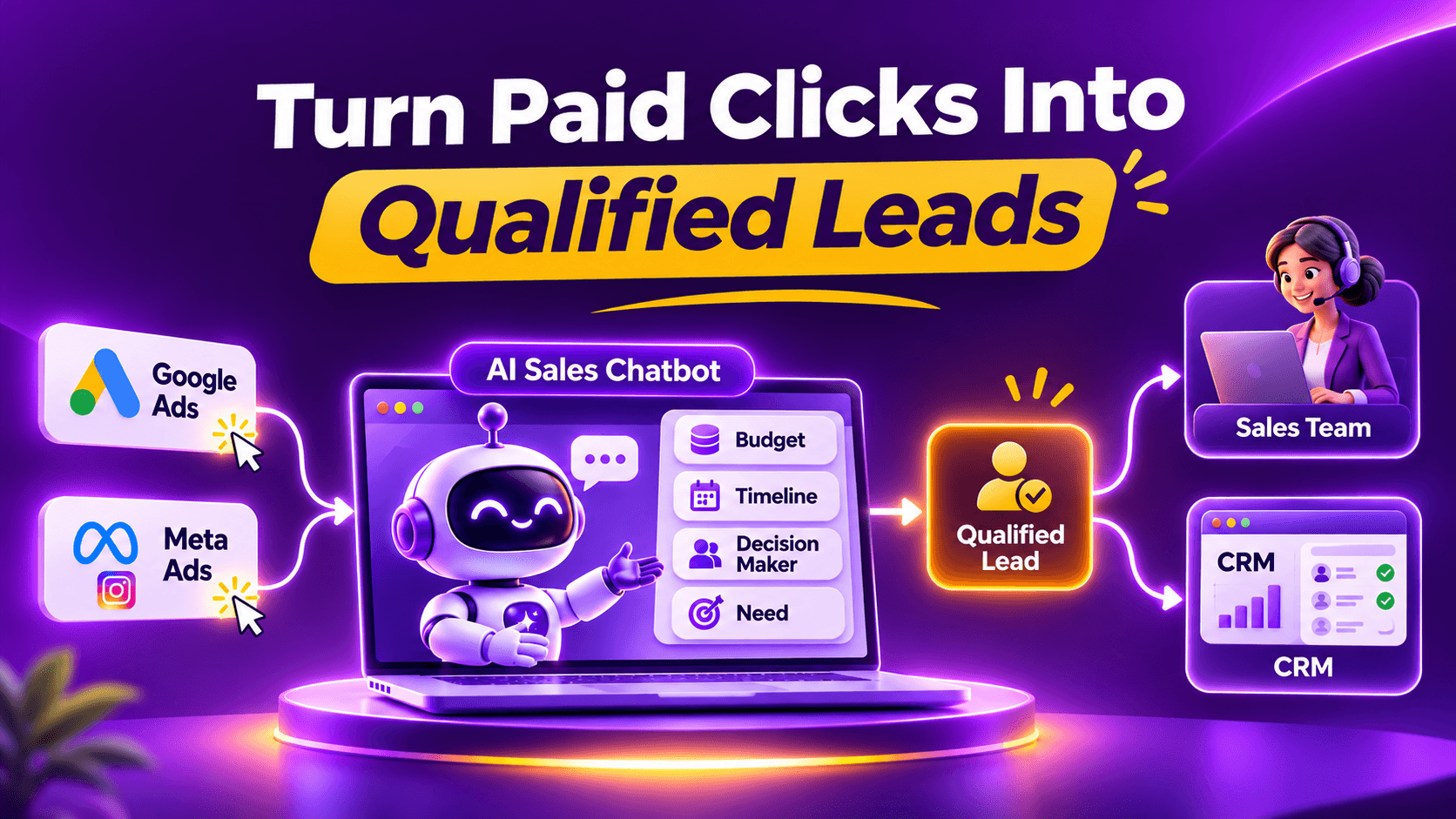
An AI sales chatbot inverts the model. It opens with a question, qualifies the visitor while they are still on the page, answers their actual questions, and captures their details only after the qualification conversation has started. Nothing waits.
3. What an AI sales chatbot actually does for paid traffic
For paid-traffic landing pages specifically, an AI sales chatbot does four jobs that a form cannot do.
Opens on landing
When a visitor arrives from a Google or Meta Ads click, the chatbot greets them within seconds. The greeting is relevant to the landing page they arrived on. A visitor landing on a product-pricing page gets a different greeting from a visitor landing on a case-studies page. The chatbot's first message is the hook that converts a visit into a conversation.
Qualifies on buying intent
The chatbot asks the questions a sales rep would ask on a first call: budget range, timeline, decision authority, specific need. Each answer updates a lead score in real time. By the end of a 60 to 90 second conversation, the chatbot knows whether this is a hot lead, a warm lead, or a research visitor.
Routes hot leads to sales immediately
For hot leads (matching budget, matching timeline, decision maker present), the chatbot sends an SMS or email alert to the sales team instantly. Many Indian SMEs call back within 10 minutes while the buyer is still on the page. The old world's 24-hour callback becomes a 10-minute callback. For high-ticket SaaS, services and consultancy sales, speed-to-first-contact is one of the strongest predictors of whether a deal closes.
Captures contact data in context
Where a form captures a name and email, the chatbot captures a name, email, phone, source attribution, and the complete qualification conversation. Sales opens the CRM record and knows exactly what to discuss on the first call. No wasted first-call re-qualification. No "let me understand what you are looking for" opening question. The sales conversation starts from a position of context.
4. The paid-traffic economics, with numbers
The clearest way to see the chatbot impact on paid traffic is through cost per qualified lead. Take the same mid-sized Indian SME from Section 1.
| Measure | Before the chatbot | After the chatbot goes live |
|---|---|---|
| Monthly paid-traffic spend | Rs 2,00,000 | Rs 2,00,000 (same) |
| Qualified clicks | 10,000 | 10,000 (same) |
| Conversion step | Form conversion rate: 3 percent = 300 form fills | Chatbot conversation completion rate: 25 percent = 2,500 completed conversations |
| Sales-qualified lead rate | 50 percent = 150 qualified leads | 20 percent = 500 qualified leads |
| Cost per qualified lead | Rs 1,333 | Rs 400 |
Why the numbers move
The chatbot moves cost per qualified lead from Rs 1,333 to Rs 400, on the same ad spend. More importantly, it increases qualified-lead volume from 150 to 500 per month. The sales team is not just working the same leads at a lower unit cost; they have substantially more buyers to work with.
Actual figures vary by vertical, keyword mix, landing-page quality, and how tight the qualification rules are. The direction is consistent across the Indian SME customers who have measured it.
5. Google Ads and Meta Ads: different traffic, different qualification
Not all paid traffic behaves the same way. Google Ads and Meta Ads produce different kinds of visitors, and the chatbot qualification flow should be configured differently for each.
Google Ads: search intent, higher cost per click, defined need
A visitor arriving from a Google search ad clicked because they searched for a specific term (for example, "ai chatbot for website" or "lead qualification software india"). Their intent is defined by the keyword that triggered the ad. The chatbot can open directly on qualification without a long discovery conversation: "I noticed you searched for [X]. What is your main use case?" The visitor already knows what they are evaluating. The chatbot's job is to short-cycle them to a decision while interest is highest.
Meta Ads: discovery intent, lower cost per click, softer need
A visitor arriving from Facebook or Instagram clicked on an ad while scrolling. They were not searching for a solution; the ad found them. Their intent is softer and their need is less defined. The chatbot should open with a short discovery conversation ("I saw you were just reading about [X]. Is this something you have been thinking about?") before moving to qualification. Expect a longer qualification flow with more disqualification along the way.
Running both channels
For an Indian SME running both channels, the chatbot should auto-detect the traffic source via UTM parameters and switch its opening and qualification flow accordingly. Google Ads traffic gets fast-track qualification. Meta Ads traffic gets a short discovery conversation first. Treating both channels with the same chatbot flow leaves significant conversion on the table.
6. What Indian SMEs are seeing
Three MagicFlow AI customers across different verticals have reported outcomes after moving paid-traffic landing pages from form-first to chatbot-first.
Distance MBA College: 41% more qualified counselling calls in 30 days
Distance MBA College moved admissions enquiries from a form-first to a chatbot-first flow on their paid-traffic landing pages. They reported 41% more qualified counselling calls in the first 30 days, at zero additional ad spend. The mechanism was multi-language capture: Hindi-first prospects from tier-2 and tier-3 cities who were previously bouncing off an English-only form.
Dnyanal Educon Pvt. Ltd.: 34% faster appointment qualification
Dnyanal Educon Pvt. Ltd., operating across 14 locations in Maharashtra, achieved 34% faster appointment qualification across all locations after replacing their enquiry forms with a Marathi and Hindi chatbot. Counsellors received leads with intent, timeline, and program interest already captured. The sales call started further along the funnel because the chatbot had done the qualification.
The Holistic Care: 29% lift in demo-ready leads within 45 days
The Holistic Care, an Indian healthcare business capturing B2B partnership enquiries, reported a 29% lift in demo-ready leads within 45 days. The chatbot captured partnership intent, readiness stage, and specific capability interest, so sales calls started with context already attached. First calls became productive demos rather than discovery conversations.
Three different verticals. Three different problems. One common pattern: paid-traffic conversion improves when the first conversation happens with the chatbot, not with a form. See all MagicFlow AI case studies.
7. Setting up a paid-traffic chatbot: five things to configure
Before an AI sales chatbot goes live on your paid-traffic landing pages, five things need to be documented and loaded into the platform.
1. Landing-page coverage
Which paid-traffic landing pages the chatbot appears on. Different pages often need different qualification scripts. A pricing page may need a budget-first flow. A case-studies page may need an industry-first flow. The chatbot should map 1:1 to your campaign structure.
2. Qualification rules
The questions to ask, the branching logic, and the lead scoring thresholds that define hot, warm, and cold. Most Indian SMEs use some combination of budget, timeline, decision authority, and specific need. The exact weighting depends on your sales cycle.
3. Source-aware opening
How the chatbot adapts its first message based on whether the visitor came from Google Ads, Meta Ads, LinkedIn, or an organic source. Source attribution flows through UTM parameters on the landing-page URL.
4. Routing rules
Where hot leads go (immediate SMS or email alert to the sales team), where warm leads go (automated nurture sequence), where cold leads go (long-term newsletter list). Clear routing prevents sales team overwhelm on launch day.
5. CRM handoff configuration
Which CRM the leads land in, what fields are populated (typically name, phone, email, source, qualification answers, lead score), and what trigger generates the sales alert.
For MagicFlow AI, the team configures all five during the managed 48-hour launch so the marketing team does not need to run an internal implementation project.
8. What to do next
If your Indian SME is spending on Google or Meta Ads and your sales team is working primarily from form submissions, there is a specific gap between what you are paying for (clicks) and what you are getting (qualified conversations). An AI sales chatbot closes that gap.
Start a 30-day free trial of MagicFlow AI and connect it to your paid-traffic landing pages. Our team configures the qualification flow for your specific vertical during the managed 48-hour launch. Within 30 to 45 days, you will have a measured delta between your form-first baseline and your chatbot-first conversion. Prefer to talk it through first? Talk to an expert.
MagicFlow AI is built in India by MagicWorks IT Solutions Pvt. Ltd. in Pune. The platform is built for Indian SME paid-traffic economics, Indian language mix, and Indian sales cycles.
Common questions from this article.

Founder, MagicFlow AI | MagicWorks IT Solutions Pvt. Ltd.
Swapnil has been building AI-first digital marketing products and running MagicWorks IT Solutions Pvt. Ltd. since 2012. MagicFlow AI is his latest venture: an intelligent conversational AI platform designed for businesses and agencies that need more than a chatbot and less than a full autonomous agent stack.