What is UTM attribution?
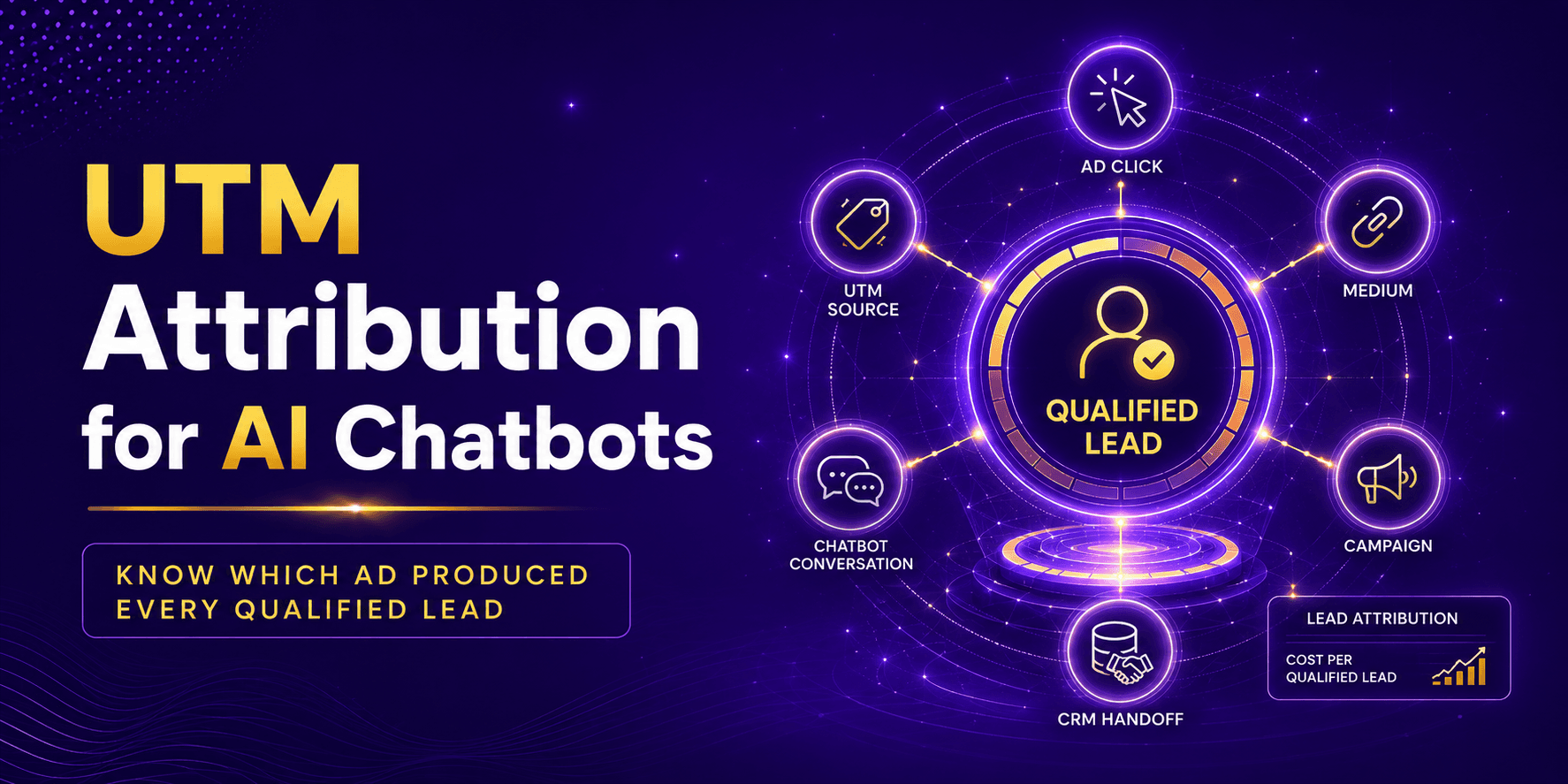
UTM attribution is the practice of using tracking parameters in a URL to identify where a website visitor came from. A campaign URL may contain parameters such as utm_source, utm_medium, utm_campaign, utm_term, and utm_content.
When someone visits a tagged URL, those parameters provide campaign context. Source identifies the platform or origin, such as Google, Meta, LinkedIn, email, or a partner. Medium identifies the type of traffic, such as CPC, social, email, display, or referral. Campaign identifies the specific campaign. Term can identify a paid keyword when relevant, and content can distinguish creatives or ad variations.
Your chatbot attribution can combine those tags with website context such as the landing page where the visitor started the conversation. This creates a lead record that explains not only who the prospect is, but also how the prospect arrived.
example.com/pricing?utm_source=google&utm_medium=cpc&utm_campaign=admissions-fy26&utm_content=hindi-videoWhat is different about chatbot UTM attribution?
Traditional website analytics records visits. Chatbot attribution connects the visit to a conversation, and that difference matters.
Imagine a visitor arrives from a Google campaign, spends three minutes on the website, opens the chatbot, asks five questions, and submits a phone number. Analytics sees the session. The ad platform sees the click. The chatbot sees the conversation. The CRM sees the lead. Without a shared identifier or attribution context, those four records may remain separate.
Chatbot UTM attribution attempts to preserve the marketing context inside the lead record itself. When the conversation begins, the chatbot can associate the visitor with source, medium, campaign, and landing page. Where available in the campaign URL, additional UTM fields such as term and content can add more detail. When the visitor becomes a lead, that context should travel with the lead.
| Without attribution | With attribution |
|---|---|
| Name: Rahul | Name: Rahul |
| Phone: 98XXXXXXXX | Intent: Looking for an admissions solution |
| Message: Interested | Timeline: This month |
| — | Source: Google · Medium: CPC · Campaign: admissions-fy26 |
| — | Landing page: MBA admissions · Lead score: 82 |
Why website forms often break attribution
The problem is not that forms cannot capture attribution. They can. The problem is that attribution is frequently treated as an analytics concern rather than part of the lead itself.
The form captures contact details. Google Analytics records the session. The ad platform records a conversion event. The CRM stores the enquiry. Later, somebody tries to reconcile them. This works reasonably well when implementation is disciplined, but for many SMEs, it is not.
Common gaps appear: UTM parameters are not passed into hidden form fields, campaign naming is inconsistent, CRM fields are missing, landing-page context disappears, sales records are exported to spreadsheets without campaign identifiers, and ad-platform conversions optimise for submission volume rather than qualified opportunity quality.
The business can tell which campaign generated forms. It cannot confidently tell which campaign generated sales-ready conversations. An AI chatbot should treat attribution as part of the lead from the beginning.
Why qualified-lead attribution matters more than click attribution
Clicks answer which campaign generated traffic. Qualified-lead attribution answers which campaign generated people worth selling to. Those are different metrics.
If marketing looks only at clicks, Campaign A wins. If marketing looks only at enquiry count, Campaign A still wins. If the goal is qualified pipeline, Campaign B wins. This is why campaign optimisation improves when source attribution reaches the sales-quality layer — the business can stop rewarding traffic simply for becoming a form submission, and begin rewarding campaigns for producing useful opportunities.
| Campaign | Clicks | Enquiries | Qualified leads |
|---|---|---|---|
| Campaign A | 1,000 | 100 | 20 |
| Campaign B | 600 | 70 | 35 |
The two levels of attribution you should preserve
A practical chatbot attribution setup uses two complementary attribution layers. Not every campaign uses all five UTM parameters, and not every salesperson needs all five displayed prominently in the CRM — but marketing should preserve the deeper data where it exists.
A good practical rule is: capture all relevant campaign information, expose the most useful fields to sales, and keep the deeper fields available for marketing analysis.
| Layer | Fields |
|---|---|
| Default lead context (what sales needs quickly) | Source, medium, campaign, landing page |
| Full UTM taxonomy (what marketing preserves for analysis) | Source, medium, campaign, term, content |
How chatbot UTM capture works
Step 1: The visitor clicks a tagged link
The visitor may arrive from Google Ads, Meta, LinkedIn, an email campaign, a partner link, or a social post. The campaign URL contains tracking parameters.
Step 2: The visitor reaches your website
The website now has campaign context in the URL or associated session.
Step 3: The chatbot conversation begins
The chatbot associates the campaign context with the conversation record. This should happen automatically rather than asking the visitor where they heard about you — the visitor usually does not know the exact campaign name anyway.
Step 4: The chatbot qualifies the visitor
The conversation may capture intent, timeline, product or service interest, contact information, and other qualification answers relevant to the business.
Step 5: The visitor becomes a lead
The system creates the lead record with both sales context (what the visitor wants) and marketing context (where the visitor came from).
Step 6: The lead reaches the CRM
Source and campaign fields should arrive with the contact record, qualification context, and lead score. Now sales and marketing are looking at the same lead.
UTM attribution and lead scoring work better together
Attribution becomes even more useful when connected to AI lead scoring. Suppose Campaign A produces 100 leads and Campaign B produces 60. At first glance, Campaign A appears stronger — until average lead score is added.
Campaign A is producing more volume. Campaign B may be producing substantially stronger intent. Once sales-outcome data is added later, marketing can begin asking which campaign produces the highest average lead score, which campaign produces the most 70-plus leads, which source produces leads sales actually accepts, which campaign produces the lowest cost per qualified lead, and which landing pages create high-intent conversations. These are much stronger questions than which campaign produced the most clicks.
| Campaign | Leads | Average lead score |
|---|---|---|
| Campaign A | 100 | 48 |
| Campaign B | 60 | 76 |
How to calculate cost per qualified lead by campaign
Once attribution and qualification are connected, calculating campaign-level cost per qualified lead becomes straightforward.
Consider an illustrative example: both campaigns spent the same amount. If both generated similar click volumes, a traffic report might show little difference. A qualified-lead report shows something important — Campaign B is generating twice as many qualified opportunities for the same spend, which creates a clear optimisation decision. This is where chatbot attribution becomes financially useful: it connects the marketing rupee to the sales-quality outcome.
| Campaign | Monthly spend | Qualified leads | Cost per qualified lead |
|---|---|---|---|
| Campaign A | ₹60,000 | 20 | ₹3,000 |
| Campaign B | ₹60,000 | 40 | ₹1,500 |
A UTM naming template for Indian SMEs
Attribution quality depends heavily on campaign naming discipline. If one marketer writes utm_source=Google and another writes utm_source=google, your reporting may treat them as different sources. If campaign names change every week without a pattern, comparison becomes difficult.
A simple naming framework is more useful than a clever one.
Source
Use the platform name consistently: google, meta, linkedin, email, partner.
Medium
Use a controlled set of traffic types: cpc, social, display, email, referral.
Campaign
Use descriptive lowercase names, such as mba-admissions-fy26 or b2b-demo-aug26.
Content
Use this to distinguish creatives, such as hindi-video, testimonial-banner, or feature-carousel.
Term
Use when keyword-level tracking is relevant. The rule matters more than the exact format — choose a convention and use it everywhere.
Four UTM mistakes that quietly damage attribution
Mistake 1: Inconsistent capitalisation
Google and google may appear as separate values in reporting. Pick one format — lowercase is usually easiest to control.
Mistake 2: Random spaces and characters
Campaign names such as “August Campaign Final New” are difficult to use consistently in URLs and reporting. Use structured names.
Mistake 3: Leaving one channel untagged
If newsletters, partner links, or paid social campaigns are not tagged consistently, those visits can end up grouped into broad or misleading categories. The resulting report looks complete but is not.
Mistake 4: Reusing campaign names forever
If every admissions campaign is called “admissions,” you lose the ability to compare quarter against quarter or campaign against campaign. A date, quarter, region, or offer identifier can make historical reporting much cleaner.
Why landing-page context belongs beside UTM data
UTM data tells you how the visitor arrived. Landing-page context tells you where the conversation began. Both matter.
Consider two visitors from the same Google campaign. Visitor A starts a conversation on the homepage. Visitor B starts a conversation on the pricing or service page. The UTM values may be identical, but the page context is different, and that difference can help explain intent.
A high-intent campaign combined with a high-intent page and a detailed conversation is a stronger signal than campaign source alone. That is why a strong attribution setup should treat source, campaign, and page context as part of the lead record.
What reports should marketing build from chatbot attribution?
Once source attribution is flowing into lead records reliably, your monthly marketing report can become much more useful. This allows management to separate traffic quality, enquiry volume, lead quality, and pipeline contribution — each a different stage of the funnel. The chatbot connects the middle layers that are often missing.
| Instead of reporting | Add |
|---|---|
| Spend, impressions, clicks, sessions, form fills | Qualified leads by source and by campaign |
| — | Cost per qualified lead by campaign |
| — | Average lead score by campaign |
| — | High-priority leads by source |
| — | Landing pages producing qualified conversations |
| — | Campaigns producing sales-accepted leads |
What should sales see?
Marketing may need every UTM field. Sales usually needs a cleaner view. A salesperson opening a new high-priority lead should be able to understand the situation in seconds.
That record gives the salesperson a starting point. The attribution is not there merely for reporting — it improves the sales conversation too.
| Field | Example |
|---|---|
| Prospect | Priya Shah |
| Interest | Corporate wellness programme |
| Timeline | Within four weeks |
| Source / Campaign | Google · corporate-wellness-search |
| Landing page | Corporate wellness services |
| Lead score | 84 |
| Conversation summary | Looking for a programme for 200 employees and wants a proposal this month. |
How agencies benefit from chatbot attribution
Agencies often face an additional problem: they are responsible for generating traffic but may not control what happens after the click. A campaign can look strong inside the ad platform while the client's sales team says the leads are poor. Without lead-level source attribution, both sides argue from different data — campaign data says one thing, CRM anecdotes say another.
When every chatbot lead carries campaign context, the conversation changes. The agency can compare campaign, qualified lead volume, lead score, client sales acceptance, and cost per qualified lead. The client can stop judging campaigns only by raw lead count, and the agency can stop defending campaigns only with click metrics. Both sides can look at the same downstream data — that makes attribution not just a marketing feature, but an accountability system.
How multilingual conversations fit into attribution
Attribution should survive regardless of the language the visitor uses. A person can click an English-language Google ad and begin the conversation in Hindi. Another visitor can reach the same page and continue in a regional Indian language. The campaign source should remain attached to both conversations.
Language and attribution solve different questions. When these layers work together, the lead record becomes much more useful than a conventional form submission.
| Layer | Question it answers |
|---|---|
| Language | Can the visitor communicate comfortably? |
| Attribution | Which campaign brought the visitor here? |
| Qualification | Is this a serious opportunity? |
| Lead scoring | How urgently should sales act? |
How to test UTM attribution before launch
Do not assume the system is working because a dashboard contains a “Source” field. Test the complete flow: create a distinctive campaign URL, open the link in a clean browser session, start a chatbot conversation, complete the qualification flow, and submit contact details.
Then inspect the resulting lead. Was the source captured correctly? Was the medium preserved? Was the campaign preserved? Was the landing page recorded? Did content or other configured UTM fields flow through? Did the information reach the CRM? Is the attribution still attached to the same lead as the conversation?
A test should follow the complete journey from click to CRM. Anything less proves only part of the system.
?utm_source=test-google&utm_medium=cpc&utm_campaign=attribution-test&utm_content=creative-aWhat happens when a visitor arrives without UTMs?
Not every visitor will have campaign tags. Organic visitors may arrive from search, someone may type the website address directly, or a visitor may follow an untagged referral link. The system should still capture the lead.
The absence of UTM data is itself useful context. The important rule is not to invent attribution — if the source is genuinely unknown, report it as unknown or according to your analytics convention. Do not force every lead into a paid campaign category simply to make the dashboard look complete. Attribution is useful only when it is trustworthy.
From campaign clicks to campaign accountability
The real value of UTM attribution is not adding more columns to the CRM. It is creating a continuous chain: ad spend, campaign, website visit, conversation, qualification, lead score, CRM handoff, and sales outcome.
Once that chain exists, marketing can optimise against what the business actually values. Not traffic. Not chatbot opens. Not form submissions.
Qualified opportunities. That is the difference between tracking activity and measuring pipeline.
Common questions from this article.

Chief Marketing and AI Officer (CMAIO), MagicWorks IT Solutions
Mohan Chute is Chief Marketing and AI Officer at MagicWorks IT Solutions, with 23+ years across go-to-market strategy, technology, and digital transformation. He built and scaled MagicFlow AI from concept to client deployment and pioneered the agency's AEO/GEO practice, helping brands earn visibility in AI-generated answers across ChatGPT, Perplexity, and Gemini.