Why 'what does it cost?' is the wrong first question
For most Indian SME buyers evaluating a chatbot, the first question that arrives is 'what is the monthly cost?' It feels like the practical question. It is not.
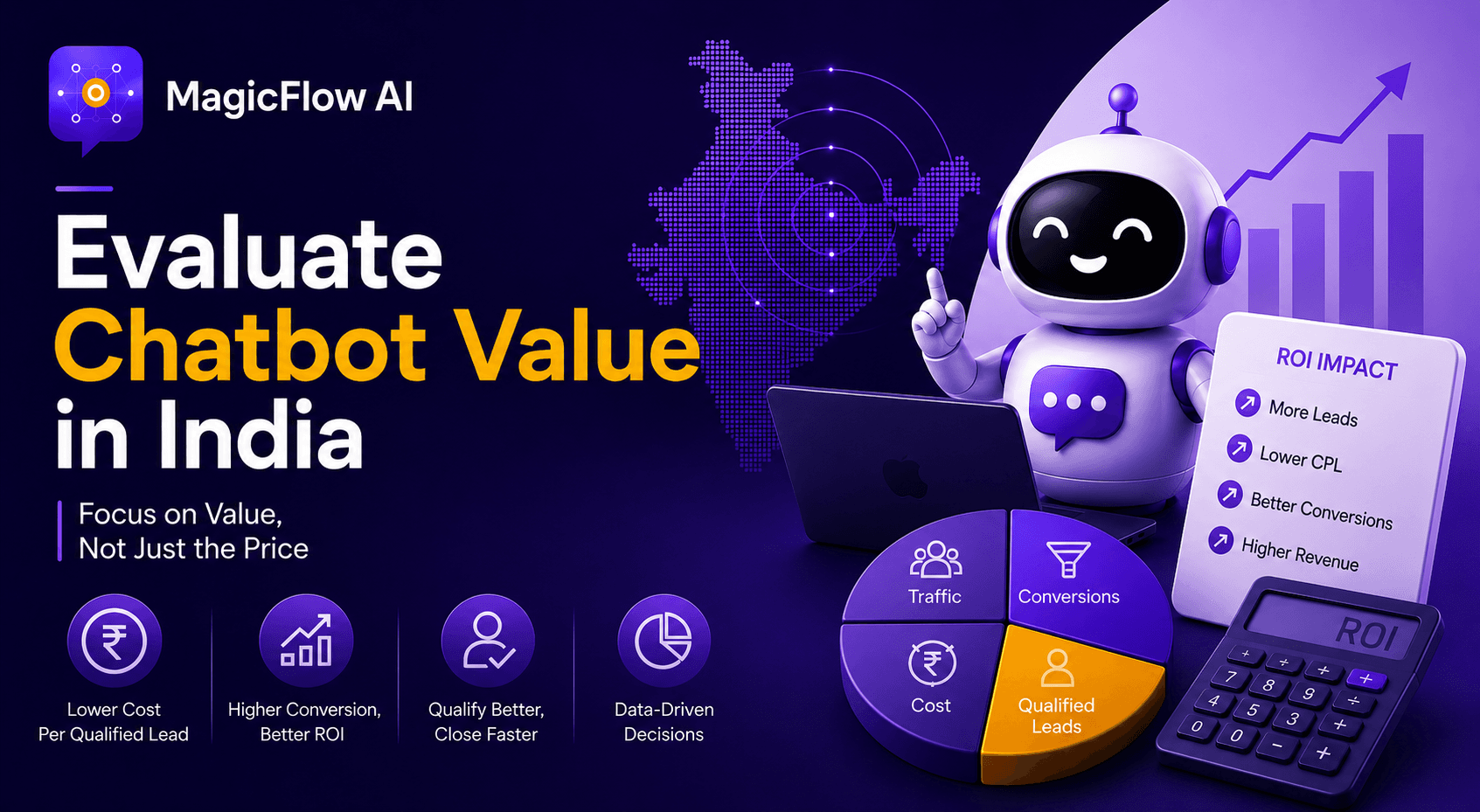
Anchoring on price creates two problems. First, it treats a chatbot as a fixed expense, when a well-configured chatbot is closer to a productivity multiplier on ad spend. Second, it compares chatbots against each other on a small number, when the number that actually matters, cost per qualified lead, sits somewhere else entirely on the balance sheet.
The Indian SME buyer who wins with a chatbot is the one who reframes the question. Instead of 'what does the chatbot cost?', the question becomes 'what does it change about my cost per qualified lead?' That reframe changes the entire evaluation.
The four numbers you need before evaluating any chatbot
Before you look at any chatbot pricing page, gather these four numbers from your own business. They are the numbers that tell you what a chatbot is actually worth to you.
| Number | What it means |
|---|---|
| Monthly ad spend | Total across Google, Meta, LinkedIn and any other paid channels driving traffic to your website. |
| Monthly qualified website traffic | Visitors who reached one of your key conversion pages (product, pricing, contact, key service). This is not total sessions. |
| Current form conversion rate | Percentage of qualified visitors who filled a contact form last quarter. For most Indian SMEs, this sits between one and three percent. |
| Sales-qualified rate on form leads | Of the leads that came through your form, how many did sales rate as worth pursuing? Usually 40 to 70 percent depending on lead quality. |
What a chatbot actually changes about those numbers
A well-configured AI chatbot changes three of the four numbers, and it does so in ways that compound over time.
It raises the conversion rate
Contact forms convert one to three percent of qualified visitors. A well-configured AI chatbot on the same traffic typically converts three to six percent of visitors into qualified leads. The chatbot does this by starting a conversation before the visitor decides to leave, asking the qualifying questions the sales team wants asked, and capturing contact details when interest is genuine.
It captures leads outside form hours
Indian SME websites see meaningful traffic in the evening, on weekends, and during festival periods. Contact forms in those hours produce lower-quality leads because visitors do not expect a fast response. A chatbot in those hours produces conversations, and conversations that happen become leads that would otherwise be missed.
It qualifies leads better than a form
A form captures whatever the visitor typed. A chatbot captures qualification answers, source data, engagement signals, and a live lead score. That means the sales-qualified rate improves too, because the sales team gets fewer 'hi' enquiries and more leads with context attached.
What it does not change
A chatbot does not lower ad spend by itself. It makes ad spend more productive by converting more of the traffic that spend brings in. That is a different thing, and worth being clear about.
A worked example: an Indian SME running paid traffic
Take a mid-sized Indian SME, say a professional education institute in Pune running admissions campaigns.
The current picture
Before the chatbot, every qualified lead is priced by what the contact form manages to convert.
| Metric | Value |
|---|---|
| Monthly ad spend | Rs. 2,00,000 across Meta and Google |
| Qualified monthly traffic | 15,000 visitors reaching key pages |
| Form conversion rate | 1.5 percent, so 225 form fills per month |
| Sales-qualified rate | 55 percent, so 124 qualified leads per month |
| Cost per qualified lead today | Rs. 2,00,000 divided by 124, roughly Rs. 1,613 |
The picture after a chatbot goes live
Nothing changes about the budget or the team. Only the conversion layer changes.
| Metric | Value |
|---|---|
| Same ad spend | Rs. 2,00,000 |
| Same qualified traffic | 15,000 visitors |
| Chatbot conversion rate | 4 percent, so 600 chatbot conversations that end with contact details |
| Sales-qualified rate, improved by scoring | 65 percent, so 390 qualified leads per month |
| Cost per qualified lead now | Rs. 2,00,000 divided by 390, roughly Rs. 513 |
The chatbot has lowered cost per qualified lead by roughly two thirds, without spending any more on ads, and without changing the sales team.
How far the example travels
The chatbot subscription is a fraction of the monthly ad spend it made more productive. That is where the value comes from.
Actual numbers vary by industry, offer and traffic quality. A B2B SaaS website will not see the same conversion rates as an admissions website. A professional services firm will not see the same as an e-commerce store. But the direction is the same across every category we have measured: chatbot conversion rates comfortably beat form conversion rates, and cost per qualified lead moves in the same direction.
Value beyond cost per qualified lead
Cost per qualified lead is the headline number. There are three more benefits worth counting in the evaluation.
Sales team time saved
A qualified lead from a chatbot arrives with the qualification answers already captured and a live score attached. That saves the sales team the ten to fifteen minutes per lead they would otherwise spend on first-touch qualification. Across 400 leads a month, that is a meaningful reallocation of the sales team's day.
Attribution clarity
Every chatbot conversation is stamped with the UTM source, medium, campaign and landing page it came from. That gives the marketing team something they usually do not have: a clear picture of which campaigns produce actual qualified leads, not just clicks. Ad budget decisions get sharper as a direct result.
Compound value over time
Every chatbot conversation adds to the pattern data that improves the next conversation. Qualification questions get better. Scoring gets tighter. The chatbot that goes live in month one is not the chatbot that runs in month six. That improvement is not something a static contact form ever delivers.
What real Indian SMEs are seeing
Value evaluation is not just a spreadsheet exercise. The numbers Indian SMEs actually report after going live tell the same story.
| Customer | Outcome | What it moves |
|---|---|---|
| Distance MBA College | 41 percent more qualified counselling calls in the first 30 days, at zero additional ad spend. | A direct movement on the cost per qualified lead number. |
| Dnyanal Educon | 34 percent faster appointment qualification across 14 locations. | Sales team time saved, in a quantified form. |
| The Holistic Care | 29 percent lift in demo-ready B2B leads within 45 days. | Qualification quality, moved by a chatbot handling the first conversation. |
What to do next
If you have your four numbers, run the calculation for your own website. The gap between your current cost per qualified lead and the projected chatbot cost per qualified lead is the case for a chatbot, on your numbers, not a sales pitch.
Common questions from this article.

Founder, MagicFlow AI | MagicWorks IT Solutions Pvt. Ltd.
Swapnil has been building AI-first digital marketing products and running MagicWorks IT Solutions Pvt. Ltd. since 2012. MagicFlow AI is his latest venture: an intelligent conversational AI platform designed for businesses and agencies that need more than a chatbot and less than a full autonomous agent stack.