The four price bands in the Indian market
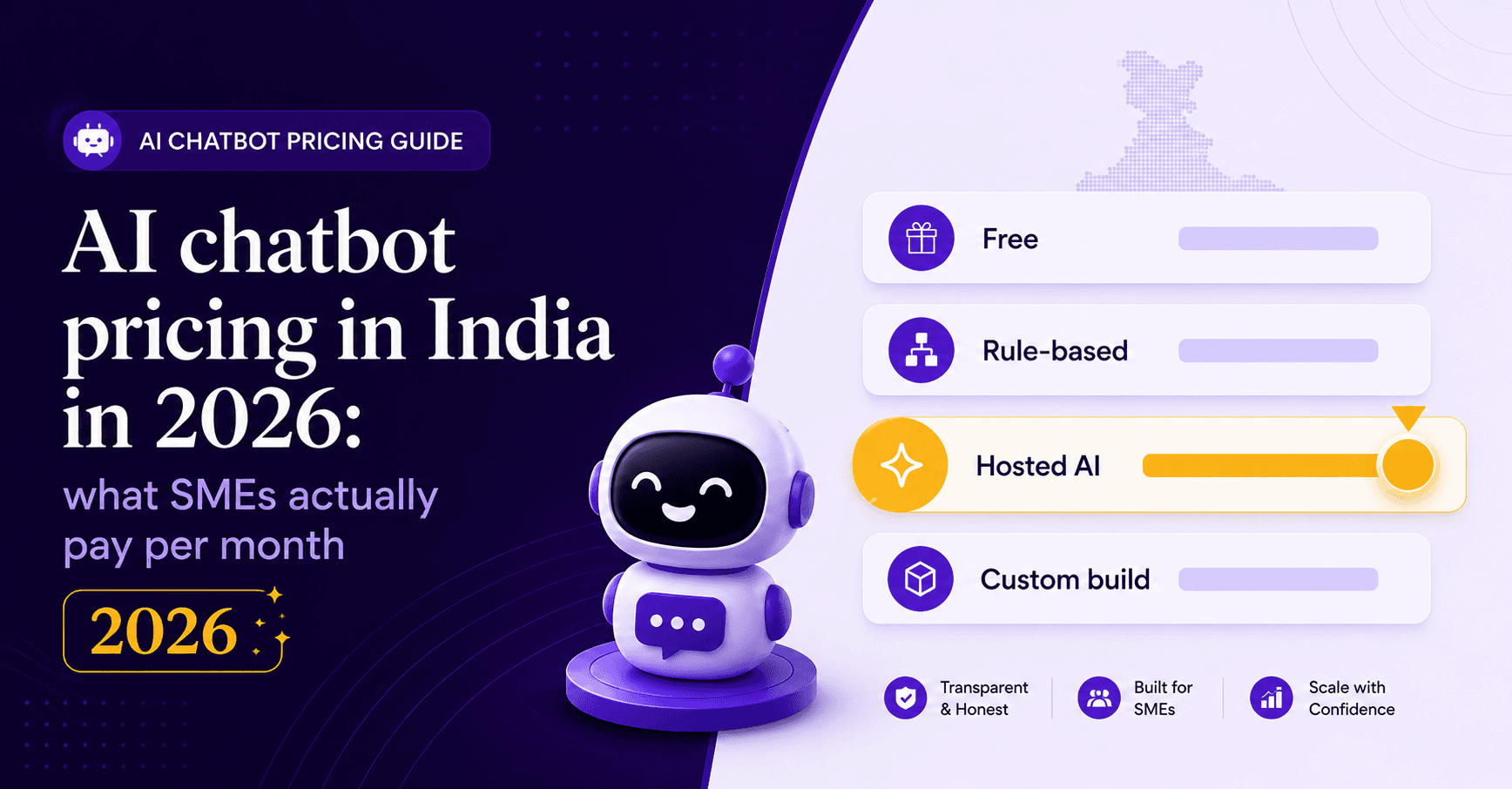
Almost every quote you receive falls into one of four bands. Knowing which one you are looking at removes most of the confusion.
| Band | Typical India cost | What you actually get |
|---|---|---|
| Free or near-free widget | Rs 0 to Rs 2,000 per month | A message box that emails you. No answers, no qualification, no attribution. |
| Rule-based chatbot builder | Rs 1,500 to Rs 5,000 per month | Button menus and decision trees. Breaks the moment a visitor types a real question. |
| Hosted AI chatbot platform | Rs 6,000 to Rs 15,000 per month | Grounded answers, lead qualification, scoring, CRM routing, attribution, support. |
| Custom build from an agency | Rs 3 Lakh to Rs 15 Lakh one-time, plus running cost | Fully bespoke. Long build, and you own the maintenance and the model bills forever. |
So what do Indian SMEs actually pay?
For a business with a normal website, a few hundred to a few thousand monthly visitors, and a sales team that wants qualified enquiries rather than raw messages, the answer clusters tightly: around Rs 8,000 to Rs 10,000 a month, or a little over Rs 1 Lakh a year.
That surprises people in both directions. Owners expecting a Rs 500 plugin find it high. Owners quoted Rs 6 Lakh by an agency find it low. Both are comparing against the wrong thing.
The comparison that actually matters
An AI chatbot is not competing with other chatbots in your budget. It competes with the person you would otherwise hire, and with the enquiries you are losing to silence.
| Cost component | One support or pre-sales executive | Hosted AI chatbot |
|---|---|---|
| Salary or platform fee | Rs 25,000 to Rs 40,000 per month | Rs 8,000 to Rs 10,000 per month |
| PF, insurance, statutory | Rs 6,000 to Rs 9,000 per month | Not applicable |
| Training, attrition, replacement | Rs 4,000 to Rs 6,000 per month | Included |
| Coverage | 40 hours a week | 168 hours a week |
| Response time to a new enquiry | 30 minutes to several hours | Seconds |
| Fully loaded annual cost | Rs 4.2 Lakh to Rs 5.5 Lakh | Rs 1 Lakh to Rs 1.2 Lakh |
What MagicFlow AI costs, and what is inside the price
MagicFlow AI publishes plans in INR excluding GST, at three billing terms: monthly, yearly at 20 percent off, and two-year at 30 percent off. Plans separate by traffic and monthly conversation volume rather than locking core features behind higher tiers.
What matters more than the number is what the number includes. On every MagicFlow AI plan:
| What's included |
|---|
| Grounded answers from your own content, using a retrieval index built from your website, documents and PDFs |
| Lead qualification with custom scripts, required capture fields and a configurable handoff threshold |
| UTM source, medium, campaign and landing-page attribution stamped on every conversation and carried into your CRM |
| Real-time lead scoring with hot-lead alerts and priority sales queues |
| Multilingual conversations with automatic language detection, covering Hindi, Marathi, Tamil, Telugu, Bengali, Gujarati, Punjabi, Kannada and Malayalam |
| Custom widget branding, CRM and inbox routing, and conversation analytics |
| DPDP-aligned data handling, hosted on AWS Mumbai, with a 99.9 percent uptime target |
Why dollar pricing costs more than the exchange rate suggests
A global platform quoting 49 dollars a month reads as about Rs 4,200, which looks competitive until you run it for a quarter. Three things happen.
The bill moves
Rupee-dollar movement changes your cost without anyone raising a price, and your finance team gets a different number every month.
The base rate is rarely the real rate
Entry tiers on global platforms usually exclude the pieces an Indian SME actually needs: CRM integration, attribution, extra seats, higher conversation volume. Priced up, the real figure lands well above the headline.
Support runs on their clock
A widget misbehaving on your Diwali campaign gets answered when California wakes up.
This is not an argument that Indian software is cheaper. It is that a fixed INR invoice with a stated conversation allowance is easier to plan around than a metered dollar bill, and cash-flow predictability matters more at SME scale than a nominal rate gap.
The costs nobody puts in the quote
Four costs sit outside almost every proposal you will receive. Ask about each one directly before you sign.
| Cost | What to ask |
|---|---|
| Setup and configuration | Often a separate invoice of Rs 15,000 to Rs 50,000, sometimes called onboarding or training. Ask whether it is included. |
| Overage | Most plans have a monthly conversation limit. Find out what happens on the day you exceed it: does it stop, throttle, or silently bill you. |
| Content maintenance | Somebody has to keep the price list and policies current. Budget an hour a month, or the chatbot will confidently quote last year's rate. |
| The integration you assumed was standard | CRM handoff and campaign attribution are sometimes premium add-ons. Without them you get conversations rather than attributable leads, which is a much less useful product. |
And GST is the fifth
Indian SaaS pricing is usually quoted excluding GST at 18 percent, so a Rs 8,500 plan invoices at Rs 10,030. Ask for the inclusive figure so the comparison is honest.
How to work out your own payback number
You do not need a spreadsheet. Three numbers settle it.
Your average deal value
What one closed customer is worth to you.
Your enquiry-to-customer rate
Roughly what share of enquiries become customers.
Extra enquiries needed to cover the fee
Divide the annual platform cost by deal value times close rate.
Worked through: a service business with a Rs 40,000 average deal and a one-in-five close rate earns Rs 8,000 per enquiry. A Rs 1.2 Lakh annual cost is covered by fifteen extra enquiries a year, roughly one and a half a month.
For reference, Distance MBA College recorded 41 percent more qualified counselling calls in the first 30 days on MagicFlow AI at zero additional ad spend. (Disclosure: the Distance MBA College outcome referenced here is also credited to this article's author, Amar Phatak, on MagicFlow AI's site.)
When the cheaper option is the right one
Three situations where paying for a full platform is the wrong call, and we will say so on a sales call.
| Situation | Why |
|---|---|
| Under roughly 500 monthly visitors | Not enough conversation volume for the fee to return. Spend on traffic first. |
| No stable content and nobody to own it | If pricing and policies change weekly, any AI chatbot will repeat stale facts confidently. Fix that first. |
| You genuinely only need a contact channel | If enquiry volume is tiny and every deal is negotiated in person, a free widget and a fast phone answer is the rational choice. |
Price is the easiest thing to compare and the least useful
Compare the four things that decide whether the fee returns: whether answers are grounded in your content, whether leads arrive scored, whether campaign source travels with them, and what happens when the chatbot does not know. A vendor who answers those four clearly beats one that is two thousand rupees cheaper.
And run the payback number before any demo. If one extra qualified enquiry a month does not cover the fee, no feature comparison will fix that. If it does, the decision was never really about price.
Two quotes at Rs 8,000 a month can be entirely different purchases. One answers questions from your content, scores the lead and tells you which ad produced it. The other puts a chat bubble on your website.
References
The following references informed the market context and figures used in this article.
- AmbitionBox. Customer Support and Pre-Sales Executive Salary Trends in India, 2024 to 2025 data. https://www.ambitionbox.com/salaries/
- MagicFlow AI. Customer outcomes and case studies. MagicWorks IT Solutions Pvt. Ltd., 2026. https://www.magicflowai.io/case-studies
- MagicFlow AI. Pricing plans and billing terms. MagicWorks IT Solutions Pvt. Ltd., 2026. https://www.magicflowai.io/pricing
- Ministry of Electronics and Information Technology, Government of India. Digital Personal Data Protection Act, 2023. https://www.meity.gov.in/data-protection-framework
Common questions from this article.

Sr. Performance Marketing Executive, MagicWorks IT Solutions Pvt. Ltd.
Amar Phatak is a Performance Marketing Executive at Magicworks IT Solutions Pvt Ltd., specializing in Google Ads, Meta Ads, lead generation, campaign optimization, and conversion tracking. He takes a data-driven approach to improving campaign performance, traffic quality, and conversions. He also shares practical insights on performance marketing, paid media, lead generation, and digital marketing strategies.