Your Google Ads are bleeding leads, and the form is why
Google Ads work. The landing page is usually where it falls apart. A visitor arrives from an ₹800 click, reads your headline in about five seconds, looks for the next step, finds a form asking for name, email, phone, company, budget and timeline, and leaves. The spend is gone. The form is empty.
Most landing page forms convert 1 to 3% of paid traffic. On a ₹50,000 monthly budget that means the overwhelming majority of it produces nothing you can follow up. The clicks were real, the intent was real, and the only thing standing between the two was six fields.
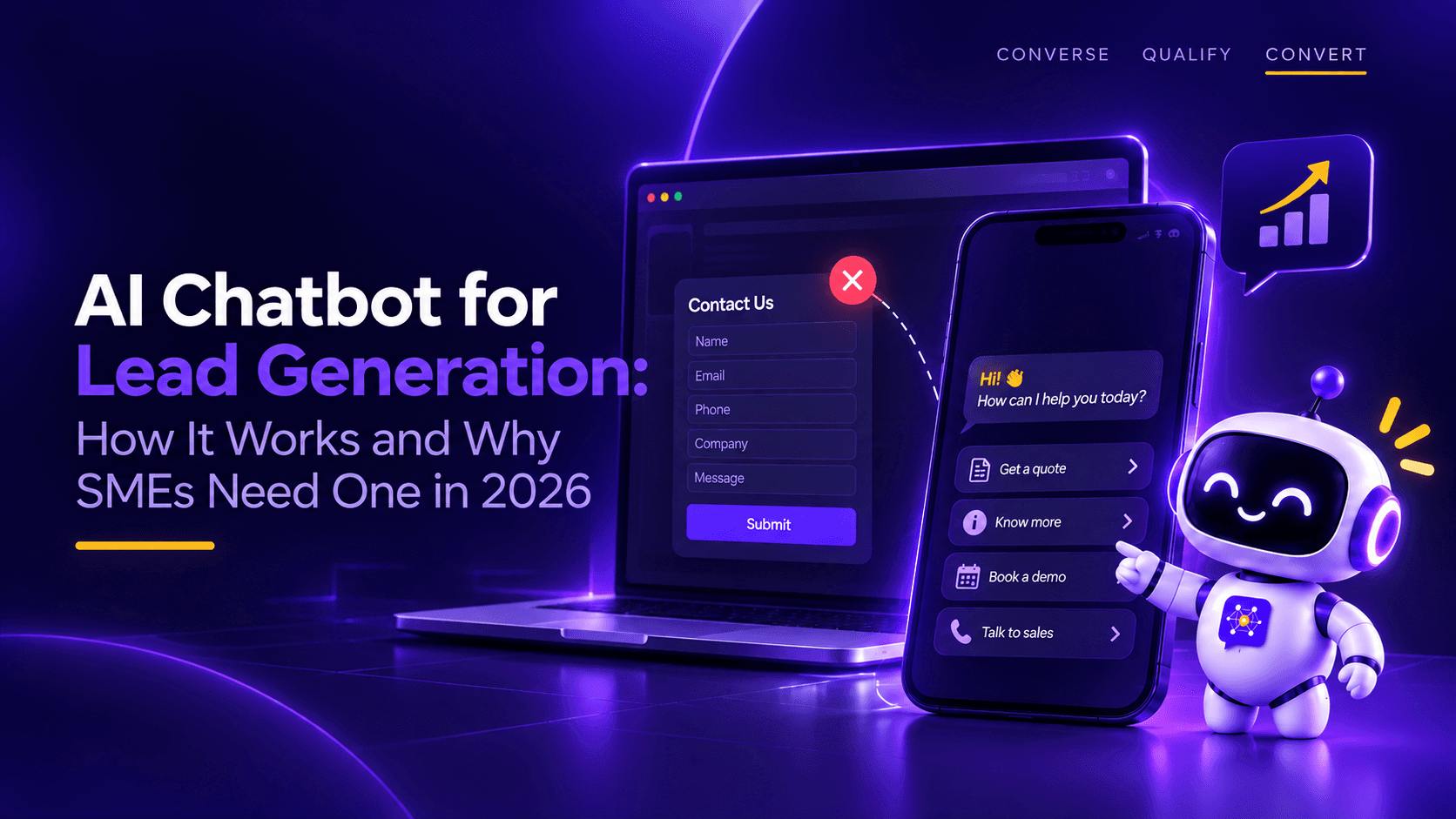
A chatbot built for paid search closes that gap on arrival. It greets the visitor, asks one qualification question, waits for the answer, and asks the next. Two or three minutes later you have their name, their budget, their timeline and their business fit, tagged with the exact keyword that brought them in, without anyone on your side being awake.
Why paid search traffic needs a different chatbot
Generic chatbots are built for customer support. They answer product questions, resolve tickets and serve FAQs, all of which are useful and none of which is what a Google Ads visitor needs. Paid search traffic behaves differently in four specific ways, and each one changes what the chatbot has to do.
They are in a hurry
You have twenty to forty seconds before a paid visitor bounces. A form spends that budget asking them to work. A conversation spends it answering the question they arrived with, and qualification happens as a by-product.
They arrive after hours
Peak paid traffic for Indian SMEs falls between 8 PM and 11 PM, and across the weekend. Your sales team is not there. A chatbot captures and qualifies anyway, so Monday morning starts with scored leads rather than an inbox of anonymous sessions.
They need attribution attached
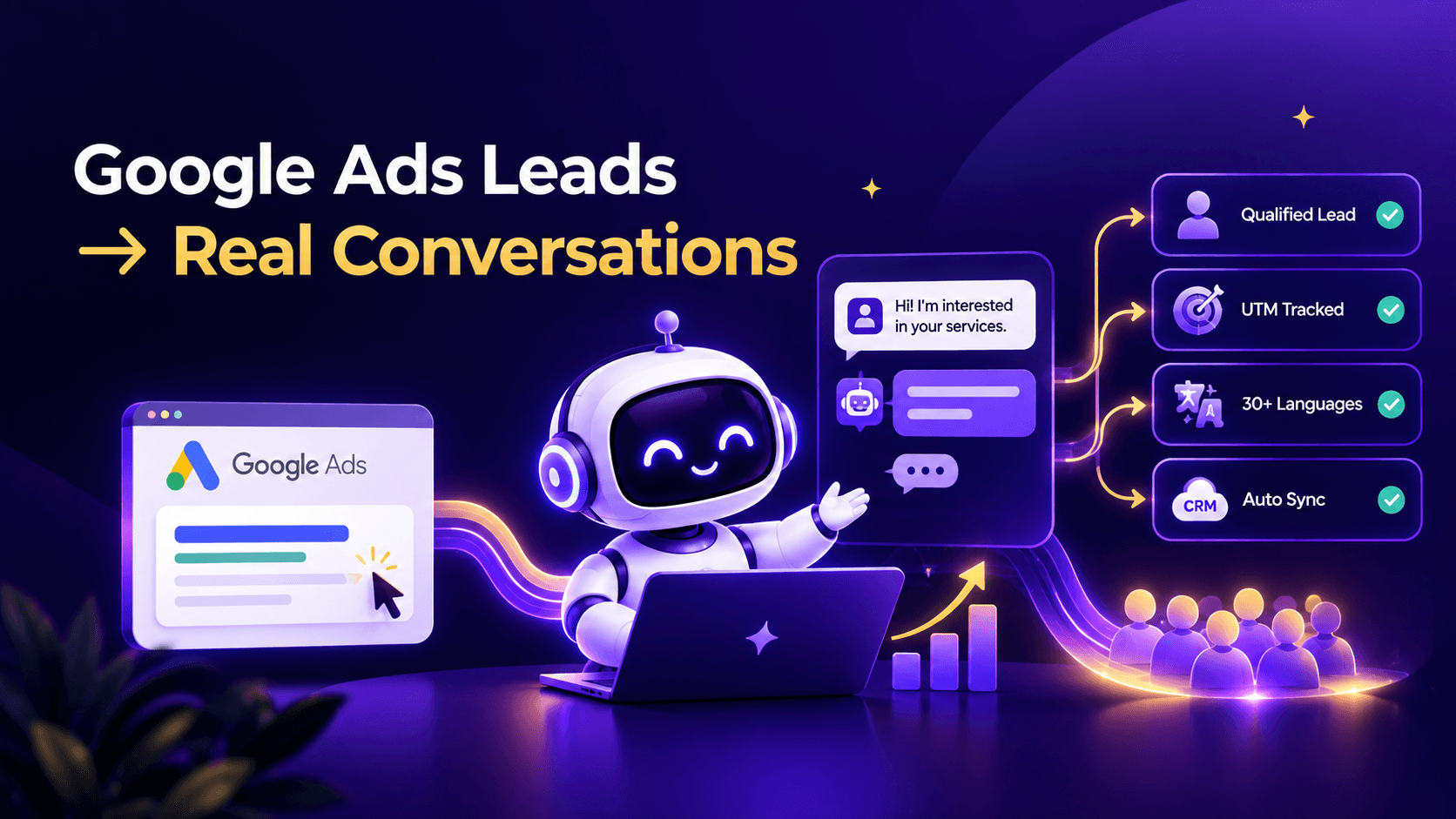
Without UTM data on the lead itself, you know which campaigns generate clicks and nothing about which generate revenue. Stamping source, medium, campaign and ad group onto every conversation is what turns a ₹800 click into a number you can defend or cut.
They may not be reading in English
If your campaigns run in Hindi, Marathi, Tamil, Kannada, Telugu or Bengali, an English-only chatbot forfeits a large share of the conversions those campaigns paid for. Auto-detection matters more than translation: the visitor should never have to pick a language before they can ask a question.
Six Essential Capabilities Every Chatbot Should Have
When you are comparing platforms for paid search, these six separate a working system from a widget. Each one exists because of something that otherwise breaks between the click and the closed deal.
Real-time lead scoring
Four or five strategic questions covering budget, timeline, authority and urgency, scored as the answers arrive. Hot leads reach your sales team immediately, warm leads go to nurture, cold leads are tagged for retargeting, and nobody sorts anything by hand.
UTM attribution on every lead
Source, medium, campaign, ad group and keyword attached to the conversation and carried into the CRM. That is what lets you say one campaign produces ₹50,000 deals while another produces ₹8,000 ones, and move the budget accordingly.
Multilingual intelligence
More than 30 Indian languages with auto-detection, answering fluently rather than translating word for word. On regional campaigns this is often the single largest conversion variable.
Native CRM integration
Qualified leads pushed to HubSpot, Zoho or Salesforce over a secure API, with the full conversation, the UTM data and the lead score attached. No retyping, and nothing lost between the chat and the pipeline.
Knowledge-grounded answers
Trained on your website, pricing, case studies and FAQs, so answers about your products and timelines come from your own material. When something genuinely is not in the knowledge base, the chatbot says so and offers to connect the visitor with your team, which is what keeps a wrong answer from reaching a buyer.
Round-the-clock capture
Weekends, holidays and late evenings included. A visitor who arrives at 10 PM is qualified at 10 PM and sits in the CRM, scored, when your team logs in.
What a 48-hour deployment actually looks like
Enterprise chatbot projects run two to four weeks of consultants, integrations and customisation, and every one of those days is a day of paid traffic arriving at a form. The concierge deployment compresses it to two days, because the integrations are pre-built and the configuration is done for you rather than quoted to you.
| Window | What happens |
|---|---|
| Hour 0 to 2 | You sign up and the concierge team runs a 30-minute call covering your campaigns, landing pages, CRM and sales workflow. |
| Hour 4 to 24 | The chatbot is trained on your content, your CRM is connected over a secure API, UTM capture is configured and lead scoring rules are set to your qualification criteria. |
| Hour 24 to 30 | It goes live on staging. Conversations are tested in your target languages and the tone, questions and branching are adjusted on your feedback. |
| Hour 30 to 48 | Production launch on your landing pages. Real Google Ads visitors start being qualified, and leads flow to the CRM with UTM data and scores attached. |
| Day 3 to 7 | Conversation quality is monitored and questions tuned, then you get a deployment report: conversion metrics, lead sources, cost per lead movement and what to change next. |
Case study: a distance MBA college traded volume for quality
A distance education provider was capturing 700 to 800 enquiries a month through a form, and most of them were not serious. Response time ran to 48 to 72 hours, by which point the prospects who were serious had already spoken to someone else.
After deploying a qualification chatbot, raw enquiry volume fell and qualified volume rose. That trade is the whole point: a counsellor's day is finite, and it should be spent on people who intend to enrol.
| Measure | Before | After |
|---|---|---|
| Enquiries captured | 700 to 800 | 250 to 300 |
| Response time | 48 to 72 hours | Under 5 minutes |
| Qualified leads | 30 to 40 | 90 to 120 |
| Lead quality | Mixed, mostly browsers | Pre-screened by qualification questions |
Fewer enquiries, three times the qualified leads. The form was never the bottleneck; the absence of qualification was.
What actually changed
The chatbot asks whether the prospect intends to enrol within six months, which filters the browsers out in the first exchange instead of three days later. Enquiry counts drop and the sales team stops paying attention to noise.
Qualification happens when the enquiry happens. Someone who asks at 10 PM is scored at 10 PM, and the counsellor opens the CRM at 8 AM to a prospect already marked hot, warm or cold.
UTM attribution showed which campaigns brought serious students rather than curious ones, and roughly 70% of budget moved to the high-intent campaigns.
Hindi alongside English captured substantially more enquiries from Hindi-medium professionals, who simply respond more when they can respond in their own language. Average time to enrolment fell from about 30 days to 18.
The ROI maths, with your own numbers
Take a B2B services business running ₹1,00,000 a month on Google Ads, at roughly 3,000 clicks and a ₹50,000 average deal. The chatbot does not change the traffic. It changes what happens after the click, in two places: how many visitors become leads, and how good those leads are when sales picks them up.
| Measure | Form only | With a qualification chatbot |
|---|---|---|
| Clicks a month | 3,000 | 3,000 |
| Visitor to lead | 3%, so 90 leads | 4%, so 120 leads |
| Cost per lead | ₹1,111 | ₹833 |
| Close rate | 10%, so 9 sales | 15% on pre-qualified leads, so 18 sales |
| Monthly revenue | ₹4,50,000 | ₹9,00,000 |
Where the second half comes from
The conversion lift is the smaller half of that. The larger half is the close rate, because a lead that arrived having already answered budget, timeline and authority questions is a different prospect from one that submitted an email address.
Nine additional sales a month against a subscription that starts at ₹2,999 is not a close call, and the sensitivity runs the right way: even at half the assumed lift, the arithmetic still works. Put your own traffic, conversion rate and deal size into the calculator rather than taking these figures on trust.
Five questions to ask any vendor
When you compare chatbot platforms for paid search, these five answers separate the ones that will pay for themselves from the ones that will sit on your landing page looking modern.
| Ask | If the answer is no |
|---|---|
| Is UTM attribution attached to every lead? | You will never know which keywords produce sales, and budget decisions stay guesswork. |
| Are 30+ Indian languages supported, with auto-detection? | Regional campaigns lose a large share of their conversions before the conversation starts. |
| Is there native HubSpot, Zoho or Salesforce integration? | Someone retypes leads by hand, and momentum dies between the chat and the pipeline. |
| Can it be live in 48 hours? | Two to four weeks of paid traffic arrives while the project runs. |
| Is the pricing flat and complete? | Per-conversation overages and setup fees appear on the invoice after you have committed. |
From campaign spend to campaign accountability
For an Indian SME where paid search is the growth engine, the highest-leverage change is rarely another round of ad copy testing. It is making sure the traffic you already pay for meets something that can hold a conversation, qualify honestly, and hand the result to sales with its source attached.
You are already spending ₹1 to 10 lakh a month on ads. The infrastructure those campaigns deserve speaks your customers' languages, connects to your CRM, and can tell you which keyword produced which closed deal.
- MagicFlow AI features /features
- CRM integrations: HubSpot, Zoho, Salesforce /integrations
- UTM attribution for AI chatbots /blog/utm-attribution-chatbot-india
- Multilingual chatbot: 30+ Indian languages /multilingual-chatbot
- Distance MBA college case study /case-studies/distance-mba-college
- AI chatbot pricing and ROI calculator /ai-chatbot-pricing-india
- Data processing and DPDP compliance /dpa
- Start your free trial today /signup
Common questions from this article.

Sr. Performance Marketing Executive, MagicWorks IT Solutions Pvt. Ltd.
Amar Phatak is a Performance Marketing Executive at Magicworks IT Solutions Pvt Ltd., specializing in Google Ads, Meta Ads, lead generation, campaign optimization, and conversion tracking. He takes a data-driven approach to improving campaign performance, traffic quality, and conversions. He also shares practical insights on performance marketing, paid media, lead generation, and digital marketing strategies.