What is lead scoring?
Lead scoring is the process of assigning a numerical priority to a prospect based on signals that indicate how likely the person is to become a valuable sales opportunity.
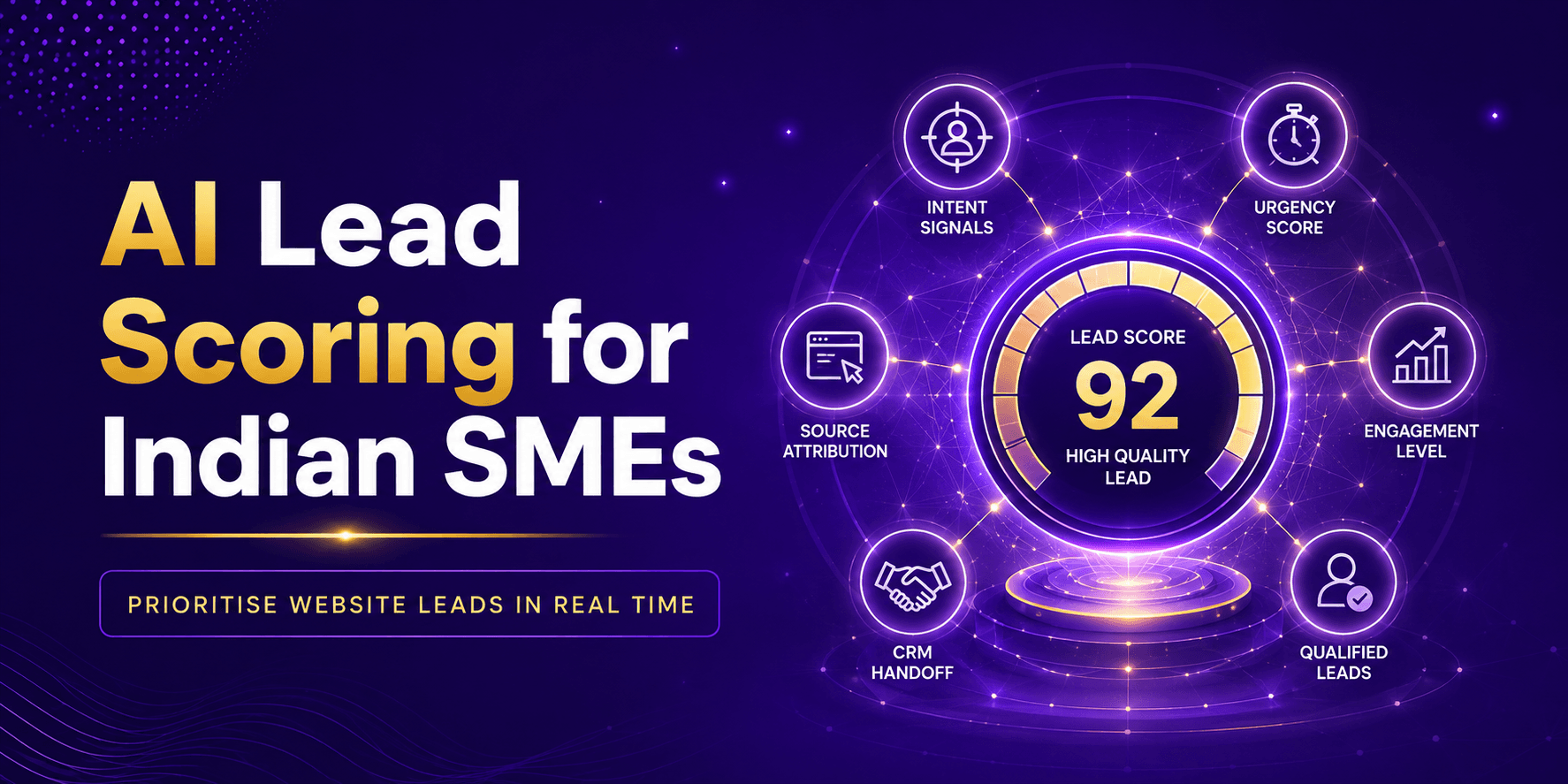
A traditional lead-scoring system may use information such as company size, job title, industry, form fields, email activity, website visits, and download history. An AI chatbot changes the quality of information available for scoring: instead of scoring only what a visitor clicked or entered into a static form, the system can also use what the visitor actually said during the conversation.
Your broader website context can also matter — a conversation started from a high-intent service or pricing page tells the sales team something different from a conversation started on a general educational article. The purpose is not to predict the future perfectly. The purpose is to give sales a better answer to a much simpler question: who should we call first?
| Signal | Question it answers |
|---|---|
| Intent | What is the visitor trying to solve? |
| Urgency | When does the visitor want to act? |
| Source quality | Which campaign, channel, or source produced the conversation? |
| Engagement | How deeply did the visitor participate in the conversation? |
Why Indian SMEs need lead scoring more than another lead inbox
Many Indian SME websites do not have a lead-volume problem. They have a lead-priority problem. Paid campaigns generate enquiries, contact forms generate entries, marketing campaigns generate spreadsheets, and website chat generates conversations — then everything arrives in roughly the same queue.
Sales has to manually figure out whether a person is serious, what they want, how quickly they need it, which campaign brought them here, whether they spent five minutes discussing the product or typed only “price,” whether this is a decision-maker or someone collecting information, and whether somebody should call now, later today, or next week.
The more traffic an SME buys, the worse this problem becomes. Without scoring, additional lead generation can simply produce additional manual qualification work. A sales representative who receives 80 enquiries cannot give each enquiry the same level of attention — even if they try, response time expands, and high-intent prospects wait alongside low-intent enquiries.
Lead scoring changes the queue. Instead of working enquiries in the order they arrived, sales can work them in the order of likely opportunity. That is particularly important for businesses such as education, professional services, healthcare, B2B services, real estate, and other categories where website visitors often need a conversation before they are ready to buy.
Lead qualification and lead scoring are not the same thing
These two terms are often used interchangeably, but they solve different parts of the problem. Lead qualification asks questions. Lead scoring interprets the answers.
Imagine an education website where the chatbot asks what programme a visitor is interested in, when they are looking to enrol, and whether they are looking for themselves or someone else. The answers qualify the visitor, but the sales team still needs to decide what those answers mean.
A prospect looking for a programme that starts this month may deserve faster follow-up than someone gathering information for next year. A prospect who arrived from a tightly targeted paid-search campaign may deserve different treatment from an anonymous direct visitor. A prospect who had an eight-message conversation and asked detailed eligibility questions may signal more intent than someone who opened the chatbot, asked the fee, and left.
Lead scoring takes qualification data and turns it into operational priority. The two systems should therefore work together: the chatbot gathers context first, the scoring model interprets the context second, and the CRM uses that score to organise the sales queue third.
What should an AI chatbot use to score a lead?
A practical scoring model for an Indian SME does not need twenty variables. It needs a small number of signals that the sales team genuinely cares about. A strong starting point uses four.
Intent
Intent answers the question: what is this person actually trying to accomplish? Someone saying, “We need a chatbot for our admissions website and want to evaluate vendors” shows stronger commercial intent than someone asking, “What is AI?”
Intent should usually carry significant weight because it comes directly from the prospect's stated objective. The chatbot can capture intent naturally in conversation rather than asking the visitor to choose from a long form dropdown.
Urgency
Urgency answers: when does the prospect expect to act? Compare “We want to launch this month” with “We are researching options for later in the year.” Both may be valid leads, but they should not necessarily receive the same follow-up priority.
Urgency is particularly useful because sales representatives already make this judgement manually. AI lead scoring simply moves the judgement earlier in the process and applies it consistently.
Source quality
Not all traffic sources behave the same way. A visitor arriving from a campaign designed specifically around a high-intent service can carry different context from a visitor who reached the website through a broad informational link.
Because an AI chatbot can preserve UTM source and campaign information, the lead score can consider where the enquiry came from. Over time, marketing and sales can refine this signal using actual conversion data — if one campaign consistently produces strong opportunities, leads from that campaign may deserve a higher source-quality score.
Engagement
Engagement asks: how strongly did the visitor participate in the conversation? Useful signals include the number of meaningful messages, whether qualification questions were answered, whether the visitor asked detailed product or service questions, how far the conversation progressed, whether contact details were voluntarily provided, and the website context in which the conversation occurred.
Engagement should not be confused with message count alone. Ten vague messages do not necessarily show more buying intent than four highly specific ones — the goal is to measure meaningful participation.
A practical 100-point lead-scoring model
Indian SMEs do not need a machine-learning research project to start scoring website leads. A transparent weighted model is often more useful because sales and marketing can understand why a lead received its score.
Each factor can first be rated from 0 to 10, then converted into its weighted contribution. That distinction is the entire purpose of the scoring system — it tells the sales team immediately whether an enquiry deserves urgent treatment or can wait.
| Factor | Weight |
|---|---|
| Intent | 40 points |
| Urgency | 25 points |
| Source quality | 20 points |
| Engagement | 15 points |
| Factor (rated 0–10) | Prospect 1 | Prospect 2 |
|---|---|---|
| Intent (÷10 × 40) | 9 → 36 | 7 → 28 |
| Urgency (÷10 × 25) | 8 → 20 | 3 → 7.5 |
| Source quality (÷10 × 20) | 7 → 14 | 6 → 12 |
| Engagement (÷10 × 15) | 8 → 12 | 5 → 7.5 |
| Total lead score | 82 / 100 | 55 / 100 |
What counts as a hot lead?
There is no universal score that makes a lead “hot.” Your thresholds should match your sales process, deal value, and traffic quality.
Treat those thresholds as a starting model, not a permanent rule. After the first month, compare scores against what the sales team actually says happened: which 80-point leads became opportunities, which 45-point leads unexpectedly converted, which variables were overvalued, and which questions failed to reveal intent. A scoring model improves when real sales outcomes feed back into it.
| Score range | Priority | What it means |
|---|---|---|
| 70 to 100 | High priority | Strong intent, meaningful urgency, or a strong combination of signals. Should surface quickly to sales. |
| 40 to 69 | Medium priority | Legitimate interest, but may need more information, more time, or a nurturing sequence before direct sales attention. |
| Below 40 | Low immediate priority | Exploratory, informational, or weakly qualified. Should remain in the system without consuming high-score sales capacity. |
Why a chatbot produces better scoring data than a contact form
A contact form is excellent at collecting fields. It is weak at collecting context. A standard form asking for name, phone number, email, company, and message often produces a lead that says only “Need details” — there is almost nothing to work with.
Now compare a chatbot conversation. Before contact details are even captured, the conversation has already produced business context, problem definition, intent, urgency, and potential fit. When the visitor finally provides contact information, the lead no longer arrives as an empty record — it arrives as a commercial conversation. That is why conversational lead scoring can be more actionable than form scoring: the system has better raw material.
| Speaker | Message |
|---|---|
| Visitor | We run an education consultancy and get around 200 enquiries a month. |
| Chatbot | What are you trying to improve, enquiry volume or qualification? |
| Visitor | Qualification. Counsellors waste too much time on weak enquiries. |
| Chatbot | Are you looking to change the process soon? |
| Visitor | Yes, ideally this month. |
How source attribution improves lead scoring
Lead scoring becomes significantly more useful when it is connected to campaign attribution. Suppose two leads look identical from their form fields: both are business owners, both ask for a demo, both want to start within one month. But the first arrived from a highly targeted Google campaign focused on your core service, and the second arrived through a broad awareness campaign.
Should the source automatically decide which lead is better? No. But should source history contribute to the score when you know one campaign consistently produces qualified opportunities? Yes. This is why UTM attribution and lead scoring belong in the same operating system: the chatbot preserves the source, the scoring model uses source quality as one signal, and the CRM receives both.
The marketing team later sees which sources actually produced high-score leads and eventual customers, which creates a feedback loop between advertising and sales. Instead of optimising campaigns only for clicks or form submissions, the business can begin optimising around qualified pipeline.
What should arrive in the CRM?
A lead score without context is not enough. A salesperson seeing “Score: 84” should also be able to understand why the score is 84.
A strong chatbot-to-CRM handoff should therefore include contact details, qualification answers, lead score, source and campaign context, a conversation summary or transcript, and relevant intent signals. The purpose is to remove the first round of detective work from the sales process — before the salesperson calls, they should already know what the visitor wants and why the lead has been prioritised.
That changes the first conversation too. Instead of “Hello, you filled our website form. How can I help?”, sales can begin with, “I saw that you are evaluating a solution for your admissions website and are hoping to launch this month. Let me understand your current enquiry process.” That is a very different sales experience.
Lead scoring should speed up follow-up, not just improve dashboards
A beautifully designed scoring dashboard has little value if the sales process does not change. The operational purpose of scoring is action.
High-priority leads should reach the right person quickly. Medium-priority leads should enter an appropriate queue. Lower-priority leads should remain available for nurturing or later review. The score should reduce hesitation — a sales representative should not need to open twelve records to decide where to start, because the queue should already reflect priority.
This is also why real-time scoring matters. A high-intent prospect is most valuable while intent is fresh. If the scoring model calculates everything overnight, it may produce an accurate number too late. The chatbot has the conversation now, the lead can be scored now, and the sales team can be alerted now.
Five mistakes that make lead scoring useless
Mistake 1: Scoring demographic fields more heavily than actual intent
Company size and designation can matter, but a prospect telling you exactly what they need is powerful first-party information. Do not ignore the conversation.
Mistake 2: Building a model nobody can explain
If sales asks why a lead received 92 points and nobody knows, trust in the scoring system falls quickly. Start transparent. Make the logic understandable.
Mistake 3: Never recalibrating the model
The first scoring model is a hypothesis. Real opportunity data should refine it. Review what actually converted.
Mistake 4: Treating every source as permanently good or bad
Campaign quality changes. Creative changes. Targeting changes. Offers change. Source quality should be based on recent evidence, not reputation.
Mistake 5: Scoring without changing routing
If every lead still goes into the same inbox and receives the same follow-up, scoring is only decoration. Tie score bands to actions.
How to implement AI lead scoring on an SME website
Step 1: Ask sales what makes a good lead
Do not begin inside the software. Ask your sales team what makes them call someone immediately, which answers signal strong fit, which answers usually mean the enquiry will go nowhere, what urgency sounds like, and which campaigns produce their strongest conversations. Your scoring logic should begin with these answers.
Step 2: Design three or four qualification questions
Do not interrogate the visitor — the chatbot should have a conversation. Ask only what is necessary to establish intent, fit, urgency, and contact path.
Step 3: Define the scoring weights
Start with a simple model. Intent can carry the largest weight, and urgency, source, and engagement can contribute the rest. Document the model so marketing and sales understand it.
Step 4: Set action thresholds
Decide what happens when someone scores 80, 60, or 25. Do not wait until after launch to decide.
Step 5: Connect scoring to CRM handoff
The score and its supporting context should travel with the lead. A score trapped inside the chatbot dashboard does not help the salesperson who works inside the CRM.
Step 6: Review after 30 days
Compare the scoring model against actual sales judgement. Look at high-score leads that sales rejected, medium-score leads that converted, questions associated with drop-off, campaigns producing strong lead quality, and score ranges producing actual opportunities. Then tune.
How do you measure whether lead scoring is working?
Do not judge lead scoring by whether the scores “look sensible.” Judge it by operational outcomes.
The scoring model has succeeded when sales behaviour improves, not when the dashboard becomes more colourful.
| Measure | What to check |
|---|---|
| Speed to high-priority follow-up | Are the strongest enquiries being contacted faster? |
| Sales acceptance rate | Are sales representatives accepting a greater share of the leads marked high priority? |
| Qualification time | Does the sales team spend less time discovering basic information already captured by the chatbot? |
| Qualified opportunities by score band | Do 70+ leads create more opportunities than 40 to 69 leads? If not, the model needs tuning. |
| Cost per qualified lead by campaign | When source attribution is connected to scoring, can marketing compare campaigns on qualified pipeline rather than raw submissions? |
AI lead scoring for multilingual website conversations
Language should not become a proxy for lead quality. A visitor speaking Hindi or a regional Indian language should be scored using the same commercial signals as an English-speaking visitor: intent, urgency, fit, source, and engagement.
This matters because Indian website conversations frequently happen in the language the visitor is most comfortable using. The chatbot should first understand the visitor naturally, then apply the same qualification logic consistently. A language preference is context — it is not a reason to lower or raise lead priority. That distinction helps create a cleaner scoring model and a better visitor experience.
The bigger idea: turn every conversation into a prioritised sales opportunity
AI lead scoring is not about replacing sales judgement. It is about moving basic judgement earlier in the funnel.
The chatbot can already see what the visitor asked, how they answered qualification questions, how urgently they want to act, which campaign brought them to the website, and how engaged they were. Sending all that information to sales without interpreting it wastes an opportunity.
Scoring turns conversation data into an ordered queue. The sales team still decides how to sell — the AI helps decide where attention should begin.
For Indian SMEs running paid traffic, that can be the difference between generating more enquiries and generating more usable pipeline.
Common questions from this article.

Chief Marketing and AI Officer (CMAIO), MagicWorks IT Solutions
Mohan Chute is Chief Marketing and AI Officer at MagicWorks IT Solutions, with 23+ years across go-to-market strategy, technology, and digital transformation. He built and scaled MagicFlow AI from concept to client deployment and pioneered the agency's AEO/GEO practice, helping brands earn visibility in AI-generated answers across ChatGPT, Perplexity, and Gemini.